21st Century Reformation is dedicated to the task of making disciples of Jesus Christ and building morally beautiful community.
Friday, March 26, 2010
Matt. 6:19-24 - Do Not Store Up Treasures On Earth
Thursday, March 25, 2010
Matt 6:19-34 – Safe in the Care of the Father
In order to meet the challenge of the teachings of Jesus, we must know how to abide in the safety of the Father’s care.
The Challenge of the Teachings of Jesus:
1. Do not store up treasures on earth, where moth and rust destroy or where thieves break in and steal.
a. What are the treasures on earth that moth can destroy?
b. What type of things (treasures) that a thief might steal?
c. So what are examples of the treasures Jesus is speaking of?
2. For where your treasure is there your heart is also.
a. This saying can mean one of three things. Which option best fits the grammar of the saying. For where your __________ is there your __________ is.
i. Where your love is there your wealth is?
ii. Where your wealth is there your love is?
iii. Where your love is there your love is?
What can we do to meet this challenge?
Safe in the Care of the Father
In order to meet the challenge, we must have faith in the care of the Father.
What does it mean to be clothed better than the lilies which are clothed better than Solomon?
How will God cloth us better than Solomon?
Why does it matter that we are more valuable than sparrows and lilies? (What is the promise Jesus is making?)
Jesus teaches that “the very hairs on our head are all numbered”(Matt 10:30). What does this say about the Father’s care for us?
Are you actually safe enough in the care of the Father to not store up treasures on earth?
Do you believe in your “heart of hearts” that you are safe enough in the care of the Father to not store up treasures on earth?
What can we do to know that we are safe in the care of the Father so that we can resist the temptation to store up treasures on earth?
Sunday, March 21, 2010
Immigration Reform - Compassionate Solution Needed
Immigration is the next big issue on the policy front. I think this issue is far more straight forward than health care. Christians began a protest today for a compassionate solution. I have had a great deal of fun learning more and more about the health care issue but solving that broken system always has pros and cons.
On the other hand, immigration is pretty straight forward. People come here to work. We need to find a much simpler way to help them come here legally. The demand for the jobs is here. We are all immigrants. We are all aliens. We need to find a far more compassionate system.
Saturday, March 20, 2010
Labels - Discipleship
So here is a link to the DISCIPLESHIP label as an example
Health Care Related Bankruptcy
Americans are increasingly at risk of financial ruin due to illness and medical expenses, according to a new study released yesterday by the American Journal of Medicine. The researchers found that illness or medical bills contributed to nearly two thirds, or 62 percent, of all bankruptcies in 2007—before the major impact of the housing collapse and current economic downturn. That’s a 50 percent increase over a similar survey in 2001 by the same researchers.Why do people go bankrupt when they get sick? Is it because they do not have health insurance or that their insurance coverage doesn't actually protect them when they need it by denying coverage or increasing the out of pocket costs.
Just over three-quarters of people who suffered a bankruptcy due to illness were insured at the onset of their health issue. But the total out-of-pocket medical costs for those who had insurance when they became ill was a steep $17,749, on average. For those who didn’t have insurance, the average debt was $26,971.
These figures underscore the need for improving our health insurance system.
Small Groups as an Enabler of Discipleship
(I am writing some stuff for our church and thought I would share my thoughts here)
In everything we do as a church, we function to expand the kingdom by making disciples. This purpose focus our community and gives us a way to reflect upon whether or not we are “doing church” according to the way Jesus has directed us to “do church”. The same purpose directs our meetings in small group and in our 1x1 discipleship relationships.
Even more foundational than the purpose of small groups is the faith that motivates our meetings as a church and as small groups.
We believe that the kingdom is within reach. we believe through faith in Jesus Christ that people can find a path to an abundant life. We believe that Jesus provides the way to live a life of righteousness, peace and joy in the holy spirit. We believe this is expressed in joy-filled families, love filled life long monogamous marriages, and lifelong mutually supportive and fulfilling friendships.
We believe that these are the outcomes that the discipleship process delivers for people . These outcomes of health lives and healthy loving relationships glorifies God.
We believe that discipleship is the process to deliver these fruit and these kingdom experiences to people that they may from the heart have a testimony of the power of the Gospel of Jesus Christ in their life. These kingdom testimonies are the fuel of our mission. It is through our testimonies of the joy and satisfaction that Jesus has given to us that we are compelled to serve Jesus by sharing His compassion and grace with others.
Small groups are a central part of this discipleship process and our understanding of how Jesus taught us to make disciples informs the way we will do small groups. So in summary, the following beliefs inform how we do small groups:
- We believe that the kingdom is available
- We believe the kingdom is experienced through discipleship
- We believe small groups are a central place to implement and model discipleship and
- We believe discipleship, the application of the teachings of Jesus, is about:
- Heart Management (Matt 5-7) - inward
- in small group
- 1x1 relationships
- in devotion
- Encouraging devotion - upward
- In small group
- in devotion
- Leading in service and the gifts of the spirit- outward
- as a congregation
- as individuals
- in 1x1 relationships
- as a small group
Friday, March 19, 2010
Jonathan Gruber - Speech on Health Care Reform
Great Explanation of costs and cadillac tax and how the Health Care Bill will be funded. Jonathan Gruber is easy to listen to. His explanation of why costs are high due to over testing and over selling of health services is compelling.
What will happen if we do not reform health care.
Universal Health Care in Israel
Hmm, maybe it is because health care in Israel works.
Who's in play: House health-care whip count
This is really cool with stats and graphics on the $$ of campaign financing from the insurance industry and % of constituents that are uninsured. Neither seem to actually correlate much but interesting anyway.
Health Care - Access, Access, Access (updated)
Nicholas D. Kristof wrote a great article yesterday on Health Care. What is striking to me is how a Christian heart of compassion ought to have a passion for increased access to health care. The link between increased access to health care and decreases in infant mortality and mortality in childbirth and pregnancy mandate Christian support for increased access to health care. This is a no-brainer.
So the question is. Why are conservative christians against health care reform? I think this is another case of ideology getting in the way of practical solutions to real life problems of human suffering.
Kristof does make one misleading statement about low abortion rates in Germany. The abortion rate in Germany is even lower than stated in Kristof's article. Germany has 35% the per capita abortions compared to the United States BUT the real reason appears to be that abortion is very restricted in Germany. Abortion is technically illegal with many loopholes in the first 12 weeks but still far more restricted than in the USA. Germany does have the oldest universal health care system in Europe.
Nonetheless, the benefits of universal health care on the well being of the society makes support for universal health care a moral mandate especially for Christians.
Friday, March 12, 2010
A Life of Being Surprised By God
So in the last few days, I have been asking the Lord, “Can you help me out even though I have no faith and no merit to commend Your response? It is almost if I am praying, “Lord, help me out here but I will understand if you don’t”. So what I decided to do was to go through a time of praying and blessing whoever comes to my mind. ….These are very tiny little random prayers of forgiveness and blessing. I also spent some time (very little time like 10 minutes) reflecting on how God has shown compassion to me in my life. I have been doing these tiny prayers of giving and receiving compassion for about two or three days….
Well, today at work I have been surprised, once again, by the clear presence of God. For me this experience feels like being in the zone feels to an athlete. If you have ever played basketball for example, there are times when everything just seems to go in. It is uncanny. As the game progresses, you just seem to get more and more confident. Athletes call this being in the zone. Well, today, I am experiencing this but with respect to being kind and joyful. Then, as always happens in such situations, the moment I reflect and say to myself, “Wow, I am in a loving, joyful place. I love this feeling”. At that moment, I sense the presence of God and the clarity that, “Oh my Lord, this is You. This is the answer to those prayers”. The Spirit bears witness with my spirit that God is a God who answers small weak prayers and the result of this grace is a joy unspeakable and full of Glory.
I have had this happen literally every time. I find that every time I move a little toward God in the exercise of faith in the Grace of God in Christ and obedience to the simple path of unconditional love that He surprises me with an unspeakable joy. So truly I can say, faith in the Christ and His path of love is the key to life.
Sunday, March 07, 2010
Joshua Redman Trio - Los Angeles - "Identity Thief"
One thing I could see is that Joshua Redman plays without any self-consciousness. This one thing makes music so freeing. We are free to be in the moment.
There is always discussion of who is the greatest jazz player of our era. For me, what makes Joshua Redman in this conversation is his melody writing. His tunes are as beautiful as Mozart. For artistic expression and melody, Joshua Redman is as good as it gets.
David Hightower - Sax Concert
David's solo is the second solo (Tenor Sax)
Tuesday, February 16, 2010
Alister McGrath - Science and Religion
Monday, February 15, 2010
Biblical Worldview and Kingdom Theology

Thursday, February 11, 2010
Best Song Ever - Dave Matthews Band - "Why I AM"
Monday, February 08, 2010
N. T. Wright - Justification God’s Plan and Paul's Vision - Part 2
Wright describes a scene where we are attempting to explain to a man who “by some accident of education” had never heard that the earth revolved and rotated. You expalin the solar system and planetary motion with props and passion over a glass of wine. The next morning you wake up to the other man’s persistent knock. He takes you to a hilltop over looking the ocean. He returns to the topic of the previous night and then the great evidence arises in the east and he turns and says, “see I told you. There it is before our eyes. Do not let all these new ideas confuse you when the fact is so clear and simple and is right there plain for all to see.” Confident that he is the defender of the truth against silly sophistication, he looks at you with a look of almost pity.
How N. T. Wright Flanks Piper on the Right
What is it in the self-satisfied traditionalist that stands in the way of learning? The first few chapters in Wright’s justification attempt to convince the traditionalist to consider that maybe there exist strongholds that are impeding their ability to see scriptures clearly. If we can all agree on a few hermeneutical principles, maybe some progress in the dialogue can be made. So here are the principles as I see them that Wright suggests:
We must look at everything Paul says. If our system cannot explain or account for some passages, then we must be open to a new perspective which can actually account for the entire system of Pauline thought. This suggestion is fundamentally conservative in that this principle is appealing to scripture. A good understanding of scripture must be able to assist in understanding other scriptures.
A sub set of this principle would be that in order to understand a passage we need to be able to understand the entire argument of the passage and how that passage fits in a larger argument.
As an illustration of this point, Wright uses the analogy of building a puzzle using all the puzzle pieces. If we refuse to use all the puzzle pieces and then force ourselves to make a picture out of the puzzle pieces remaining, we will not get a good picture or a clear understanding of the intended scene. So too, if we do not take every passage into account, we will not be able to understand the entire picture of Pauline thought nor will we have much success or assurance that we understand what little bits we do think we have pieced together.
A second principle is that it is important to look to scriptures and the world of scriptures as opposed to tradition and the world of the 16th century and the thought patterns of the 16th-17th centuries as the authority in scripture interpretation. This point is so obvious and humorous at the same time. Wright is clearly flanking Piper on the right. Is it conservative to point the believers to the 1st century or the 16th? To scripture or tradition? Should we illuminate Paul with the world of Paul or the world of Calvin and Luther?
A great example of this principle is Luther’s own appeal to scripture and the world of scripture to make one of the key revelations of the reformation. Luther appealed to 1st century usage of the word metanoia. Luther insisted that a more accurate translation of Pauline though would be “to repent” and not “to do penance”. On what basis could Luther make this argument but to go back to scripture and the use of such word elsewhere in the first century. Wright is out reforming the reformed purists by using examples of how the reformers did exactly what he is doing, (i.e. looking to scriptures as the final authority as against our traditions.
A last example of this is to make the distinction between the questions we are attempting to answer via the text and the questions Paul was trying to answer via his text. ewvery generation has its controversies and every generations theologies are an attempt to answer these controversies. But isn’t it more important to understand what Paul problems Paul was trying to solve when he wrote the text. The aim is to avoid eisegesis and get back to exegesis.
If we are honest, each of Wright’s principles are an appeal to true scriptural conservatism as opposed to a conservatism that attempts to conserve tradition. Indeed, N. T. Wright is flanking John Piper on the right.
Sunday, February 07, 2010
N. T. Wright On Justification - Part 1
NT Wright On Justification - Part 1
I am reading N. T. Wright’s book on justification and John Piper’s critique of N. T. Wright as well and John Owen’s original work on “Justification by Faith” (or here). My goal is actually personal in that I believe my own spiritual growth needs a big dose of grace. As we receive grace, we become more gracious. I have six children and I need a lot of grace to remain gracious. I find good exposition to be sanctifying and inspiring for me.
My blog plan is that while I read I will summarize and make comment.
The first thing one must understand and appreciate is how remarkably conservative N. T. Wright is. Many conservatives seem to paint Wright as a theological liberal but in the pantheon of New Testament scholars N. T. Wright is stand in the solidly if not even extremely conservative camp. In fact in this book, Wright’s approach is to flank Piper and co. on the right. It is Wright who appeals to scripture as opposed to tradition. On this note and with many illustrations, Wright begins his book, as he must begin all his more thorough works, with an appeal to method and an explanation of the role worldview of the many actors in hermeneutic process.
An Appeal to Method and the Role of Worldview
This section and a far more expounded discussion of method (see The New Testament and the People of God) is extremely important to understand thoroughly. The basic point is so simple. The reader must be very aware that, as a subject, he or she plays a role in the reading of the text. If one is humble in light of this awareness, the reader will seek all manner of evidence in an attempt to get to the mind of the author of the biblical text. What we are after is not our experience of the text or confirmation of our previously held convictions regarding the meaning of the text. We are always after the illusive meaning of the text itself. Therefore, it is vital that we tough the world that the author touched by immersing ourselves in the world of the author. This process is called contextualization. Is it not more important to learn about the world of Paul, than the world of the reformers if we are after and seeking to understand the bible. This process of radical doubt concerning our own preconceptions and even doubt about our traditions is the basis of conservatism and sola scriptura.
N. T. Wright illustrates this principle with many illustrations but these will have to wait for tomorrow....
Monday, February 01, 2010
How To Survive a Mid-Life Crisis
(this is part of a larger essay...It starts by explaining why the ego of a person starts to fight for survival in the mid forties)
What is a Mid-life Crisis?
The human self develops a heightened view of itself which he or she desires to project out into the world. For men, this projection of the ego is accomplished through achievements. Throughout life, a tension exists between what the person is in life in the present, his status and accomplishments, and what he would like to be or thinks he ought to be recognized as. This psychic tension must be resolved. Throughout life, we most often resolve this tension of our current position and circumstances and what we desire to be by projecting our vision of our self out into the future. We may not be accomplished and strong and victorious but we can conceive that we one day might accomplish all that our ego sets out to do in the world.
A crisis occurs at 45-55 when a man realizes that the resolution of his shame and pride, the desires of the self, through the acquisition of a preferred future is not likely. Time is running out. At this point in life, the strategy of using a projection into the future of a better you or better position or circumstances is no longer tenable. The psychic tension is irresolvable using the future projection method. It is not likely that the self will be able to affirm itself through future accomplishments. The ego begins to go into crisis. If a man is not well practiced in the process of voluntary death to self, he will not know how to put his ego to death. Instead, his ego will fight to create, before time runs out, the preferred future or vision of himself. The ego refuses to die and begins to seek affirmation in manic fashion.
Death to Self
When encountering a person or developing a relationship with a person, if one is well versed in the problem of human pride, it is not difficult to predict that this man will have a mid-life crisis. Jesus said, “If anyone wishes to follow me, he must deny himself and take up his cross daily and follow me.” Everyday provides opportunities to die to self. Life is social and men are constantly managing their place in the politics of their social networks and relationships. The disciple hates this jockeying and managing one’s power and position and the perceptions of others. To live on a spiritual basis is to actively cease participation in this worldly dynamic. When a person disrespects us, which happens many times in a given day, we actively allow this person to hold this opinion. We forgive and we cease managing people’s perceptions. We are not in management. Only God is in management. It is easy to see and observe if a person knows this practice of death to self. Death to self has thousands of permutations because life provides thousands of opportunities and different circumstances to die to self, to allow our ego to be humbled both before others and before ourselves. But most men are continually acting according the to the worldly system through which the individual attempts to project himself as successful, mature, wise, healthy and kind.
‘Wow, he is skilled and together. I wish I was like him”. This is how every man wants to be perceived, and in the minute relationships of life, at home, at work, in church, we size up ourselves and the other men. In each encounter with another person, egos are present and seeking power and recognition of some sort. This is the process which the disciple of Jesus is actively disengaging from. The disciple must be aware of the process, and, in this awareness, it is easy to observe other men acting out according to the desires of the pride and ego. So it is easy for a follower of Jesus to be aware of whether another man is attempting to follow the teachings of Jesus in the midst of our interactions with them or whether they are following the motivations of their self, their ego. Are we “denying our selves, taking up our cross, and following Jesus” or are we following the desires of our self?
So here is the first key to surviving a mid life: We must start learning how to deny ourselves and take up our cross and follow Jesus in the small areas of life, many years before we reach this critical age of our mid-forties.
Learning to Deny Self Daily
- Seizing the Opportunity (in the moment): The Actual Game
- Silencing the Self
- Asking for power and faith to deny self - Mediating the situation with the presence/intimacy with Jesus Christ.
- Strength to resist the persistent ego (refusal to die)
- Faith to see it as the cross (obedience to God)
- Compassion for your adversary (he is sick; this battle is sick; the whole war is sick)
- Comfort and affirmation as a child of God
- Death to Self in the Big Opportunities (reflection) : Practice
- Sober moment of reflection
- Thorough inventory
Saturday, January 30, 2010
Rigorous Honesty - Enabler to Discipleship
Sunday, January 03, 2010
Barnanke 01/04/2009 - Regulation Not Monetary Policy Most Surgical Means to Prevent Housing Bubble
This speech by Bernanke is very simple to understand. His speech has two parts to make his ultimate point.
1. He compares the actual target rate with the rate suggested by the Taylor model. He modifies the Taylor Model with consideration as to whether variations in inflation are considered temporary or permanent. IF we make this adjustment then the actual target rate was pretty much in line with teh suggestion of the Taylor Model.
2. He shows that this "good" monetary policy if the only variable in influencing housing prices, we see that housing prices significantly out paced the influence of monetary piolicy (i.e. interest rates). In fact we see that LENDING PRACTICES, appear to have generated the new demand for homes and the subsequent housing bubble. The introduction of proliferation of esoteric products which offer exceedingly low initial payments account for the greatest shift in housing prices and thus the housing bubble.
3. Therefore to avoid the housing bubble, which led to the most significant economic crisis in modern history, the primary cause was LENDING PRACTICES. Therefore, regulation of lenders would have been the most effective tool in avoiding the housing bubble.
4. Therefore, regulation of lending practices must be implemented if we are to avoid a recurrance of the recent economic problems.
brad
Saturday, December 26, 2009
We are all Tiger Woods
This is a really good article about Tiger's all too human problem.
Saturday, November 14, 2009
Thursday, October 29, 2009
What Makes the Good News Good? Seeing the Glory of Christ" :: Desiring God
This is a good sermon on what we are trying to preach this weekend.
1. The Gospel of the Kingdom is the promise that in Christ the quality of life of heaven is available now
2. The Cheif characteristic of heaven is the presence of God
3. The chief characeteristic of the quality of life of heaven is direct, intimate relationship with God
4. The kingdom of God is available means intimacy with God is available.
5. The Gospel promises intimate relationship with God. (John 17:3; John 4; Romans 8:15-17)
6. This relationship with God is life transforming . (2 Cor 3:16-18: Phil 4 (cast anxiety....)
Therefore..
1. Believe in the promise of life transformation through relationship with God
2. Pursue intimacy with God.
amen
brad
Monday, October 19, 2009
Todd Hunter Explains What is Wrong with Emergent
In the interview, Todd Hunter mentions “two big problems” with the Emerging movement. (I have my own problems with the movement but we’ll discuss those at another time). Todd’s problems with the Emerging movement are:
“First, the emergents are so sensitive to issues of community, relationship, egalitarianism, and being non-utilitarian in their relationships, that evangelism has simply become a synonym for manipulation—a foul ball, relationally. If you and I were work colleagues and I built a relationship in which I could influence your journey toward Christ, that would be considered wrong in these circles. I cannot be friends with you if I intend to lead you to Christ. “
As Todd points out, the Emerging Movement isn’t something you can “broad-brush”. It’s much too slippery to get a handle on enough to make any real, substantial criticisms, (which is one of my problems with it, but I digress).
In Todd’s response I would tend to agree, as he states it, but I would also agree with those who feel it’s manipulative to make friends for the purpose of evangelism. I guess I would amend Todd’s statement to say, “I cannot be friends with you only because I intend to lead you to Christ.” It’s the recruitment motive that bothers me, and I think a few others, when it comes to targeting people as conquests rather than learning to love people no matter what their faith, or whether or not they eventually become followers of Jesus. I think what has to be intentional is our love of others, not evangelism itself. I believe in intentionally loving someone and praying for God to reveal Himself to them, but I do not believe in intentionally targeting someone simply to convert them to my faith.
One helpful question I believe we should ask is, “Am I willing to be someone’s friend for the rest of my life, even if they never convert to my faith?” If at any point in the relationship I would abandon the friendship and move on to a better prospect then, I believe, we’re not really fulfilling the Lord’s command to love others. Love isn’t conditional. It should remain and be sustained regardless of whether or not it is reciprocated. Love should continue apart from agreement on matters of faith.
Todd’s second problem is the one I take the most issue with.
“Second, after 10 or 12 years of the emerging church, you have to ask where anything has been built. Evangelism has been so muted and the normal building of structures and processes hasn't moved forward because there's no positive, godly imagination for doing either evangelism or leadership.”
Thanks for saying this for all us who value the proclam,ation of the Gospel and the use of wise method as opposed to the emergent organic way.
Sunday, October 18, 2009
Bono - Rebranding America
“... support the Millennium Development Goals, and approach next year’s summit with a global plan to make them a reality. And we will set our sights on the eradication of extreme poverty in our time.”
Monday, October 05, 2009
Surfacing the Problem by Knowing the Destination – The Ultimate Goal
Picture a man preparing for a trip to New York. He begins planning maybe a few months in advance. He books a room. He books a flight. He packs his bags. He prepares the agenda for the event when he arrives at his destination. In this case, the man is very excited about the trip because he is going to be the best man in his best friend’s wedding. He has prepared a speech and prayed that he will be a blessing to his friend. He has even prayed for his friend’s marriage that the couple will find purpose, friendship, and satisfaction in raising a healthy family together.
Our traveler rides to the airport with his wife and is filled with a sense of peace and confidence. This is going to be a great wedding, he says to himself. His flight is flight 87 for New York. He checks his bags and finds the gate. He sits next to another man in the waiting area. He gets his boarding pass and boards the plane. The planes are all lined up waiting their turn to accelerate down the run way.
The planes on this runway are all 737s and they take off to the East and fly over the Los Angeles basin before realigning themselves as needed for their ultimate destination. Our traveler has taken this flight before and likes to look out the window over the great deserts of Arizona and Texas as the flight takes its path to the South before heading up the East coast to New York. This particular flight lands in New York near sunset and the view coming up the eastern seaboard and into Manhattan is profound. After flying over 2,000 miles of desert and then the farms of the Eastern United States, the astute passenger can see the great massive city in the distance. As the plane draws nearer, you realize there are 8 million stories in this city. You feel as if you can see into the apartment windows and into the lives of the various cultures of New York: a Puerto Rican family here, the famous Italian and Irish districts there, Harlem and the birth of Jazz to the North of the city, wall street and the New York stock exchange. I picture the history of so many of the American people groups. My mind thinks of African Americans listening to a Joe Louis fight around a radio with hope of freedom and dignity. As the plane enters the city and fly’s out over the Atlantic, the statue of liberty comes into site.
I remember when I first visited New York with my soon to be wife. We rode the subway into the city from JFK airport. We got off the subway and walked up the stairs to the streets. When I stepped out onto the street, I could not control the emotion as I began to cry. The massive skyscrapers are like no others on earth. The racial tension is palpable. The story of humanity is distilled in every scent and every sight.
All these memories fill our traveler’s mind as he prays for his family back home. The plane hovers over the LA basin and begins to gain altitude. With his eyes closed, he hears the pilot speak over the PA system as the plane backs to the North. “Ladies and gentlemen, welcome to flight 87. We will be landing in San Francisco in 56 minutes”. Our traveler’s eyes dart open as he realizes, he isn’t going to New York.
The Meaning of the Parable
God puts in our hearts a visions for the great city. He has shown us that we can arrive at our destination just as the first century church did. Our model is Acts chapter two. We are part of a great story of each generation struggling to build a community immersed in the presence of the Holy Spirit and directed into holiness by the teachings of Jesus. Contemplation of this purpose and the hope of arrival is in itself life transforming and filled with peace and joy.
As communities begin to launch down the run way toward their destination, they all look similar. The accelerate down the same runway all headed in the same direction. This is Christianity. We all have the same faith in Jesus as our savior. We all have the same ticket. We are all on flight 87. BUT the fact is we all have different visions of where we are going. Some understandings of the ultimate destination are quite mature and biblical. Some are merely going on a vacation. But ultimately, it is the pastor, the pilot in this analogy that will determine the ultimate destination.
Not to offend any Bay Area residents, San Francisco is a beautiful city and all, but it ain’t New York City. The Transamerica building isn’t the Empire State Building. Oakland isn’t the Bronx. Berkeley isn’t Greenwich Village. There is a Broadway street in San Francisco but it isn’t the Broadway. So too if we seek to become like the successful church down the road, we will not find ourselves in Acts 2.
Acts 2 or The 20th Century Models
There is only one destination for the New Testament church and that is to model itself in principle after the prototype church of Acts chapter 2. The New Testament has a wonderful statement that teaches us to look to God’s model and not each other as our goal. Paul said of some early Christians, “They compare themselves with themselves and have no understanding”. It is not unless we seek as our destination the New Testament ideal that we will travel in the proper direction and find unity in the body.
The first and most important key to understanding the Acts Chapter 2 community is that the Holiness and beauty of the Acts 2 community is impossible to attain naturally. As we set the target or the preferred future to which we are going to strive to enter, the vision must elicit the response, “We can’t get there from here”. A key principle of faith is that apart from God it is impossible to get from “our here” to “God’s there”. This is true in our individual lives and it is just as true as we set our vision for our corporate life. So often, we settle for less than God’s vision because we cannot see how the community we are part of could ever get from here to there. So instead, we set more “practical” goals. We choose to attract people through natural means. We use good music, a naturally charismatic speaker. We avoid challenging the listeners with the uncompromised biblical standard of sacrifice. We catter to people’s natural inabilities and
The Standard of the Acts 2 prototype is so beautiful that this ideal reveals to us our wretchedness and sin. It is the uncompromising contemplation of this biblical model of community that brings us to a place of mourning and spiritual poverty. In the Acts 2 church no one had any needs that were not cared for. In our communities, if a man loses his job is it not possible that he could lose his home as well. Is there not someone in the church to pay his mortgage for a time and another to offer him a job? Is this love the norm in our community? If it is not, then contemplation of the biblical model drive us to ask why is this not our experience and what do we need to do to align our lives with the kingdom model.
Does the lady in the pew next to us in church know how to get to our houses? Are our lives and our communities intimate enough that we take our meals together and meet regularly in one another’s homes? Is such intimacy threatening to us? If it is, can we say that the gospel has set us free from shame? Are we free from the curse in Adam if we still hide and live guarded lives?
peace,
Friday, October 02, 2009
Fear of Man and Fear of God - Piper
Saturday, August 15, 2009
Jubilee - What The Bible Says about Economics Part 1
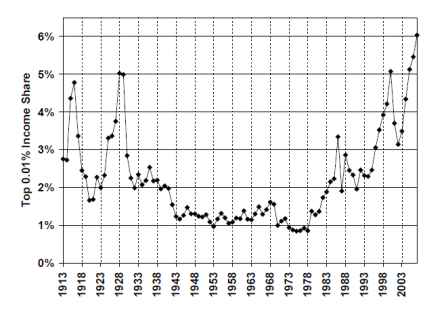
This image is powerful...
What does this show? Well the great times of wealth polarization were 1928, directly prior to the great depression, and the first decade of the 21st century. Why does wealth polarization lead to depressions? It is very simple. It is like monopoly, when the common person, the middle class, has very little discretionary funds, then demand falls and depressions/recessions happen.In the 2008-2009 example, the falling demand was temporarily held at bay by increasing the value of homes and thus giving the false perception of wealth to any people. These people then leveraged their wealth by taking out seconds on their homes. This cycle put cash in people's pockets and a surge of demand. But when the bubble burst, the true lack of wealth amongst most consumers was revealed and consumer confidence, (i.e. demand) fell drastically.
So the real cause of the problem is the polarization of wealth. Thus, the biblical solution - Jubilee. Jubilee is a time of wealth re-distribution and the forgiveness of debts. In our day this is known as, bankruptcies and loan modifications.
brad
Friday, April 17, 2009
My Story
My story is the story of a seeker. This process of seeking began when I was about 10 years old. I remember at 10 or so I saw a World Vision television show about the 1973 famine in Tanzania, East Africa. Prior to this documentary, I was unaware of the problem of poverty. The contrast between the affluence of my neighborhood and our nation with the reality of suffering in other parts of the world was irreconcilable. To me as a teenager I was profoundly aware of this ethical idea. What alarmed me even more than the suffering itself was that no one else seemed to care. My awareness of poverty and of the apathy of people around me was reflected in the music I listened to, the clothes I wore, and my relationships with my peers and my parents. It even affected how hard I studied.
At university I began to study the root causes of this problem of poverty and I discovered politics. I was studying to be a medical doctor. My major was Medical Anthropology and I wanted to work on the most fundamental problems of infectious diseases and clean water with an emphasis in East Africa. As I studied the historical roots of these people's suffering and the realities of global trade and economics, I came to the realization that the problem was not only human apathy but was the result of the intentional acts of the powerful. What was needed was a political solution. Needless to say, I took a serious turn to the left.
Our test case was the problem of South African Apartheid. My activism got me face to face meetings with some very powerful people. We spoke truth to power, but I was profoundly struck by these men's stubbornness. Eventually our frustration resulted in an escalation of the conflict, and my friends and I found ourselves in jail. At this time y heroes were Ghandi, Martin Luther King, Malcolm X and Jesus. All spoke truth to power, met resistance with courage, and died well fighting for the poor. When I graduated from college my understanding of Jesus was of a political activist motivated by compassion who was killed as a result of his advocacy for justice and his compassion for the poor.
After college, for some reason I remember I attended a youth group at a church. I remember arguing with the youth pastor, who appeared rather square to me, that Jesus did NOT die for his sin. His advice was that I read the Bible and start in the Gospel of John. Never one to back down from a challenge, I went home, found a Bible and opened to the Gospel of John.
The story begins with John the Baptist's first encounter with Jesus before Jesus even started any public ministry. Seeing Jesus walking toward him, John the Baptist says "Behold the Lamb of God who takes away the sin of the world." This verse struck me. I read it again and again and I began to weep. In one moment, I realized that though Jesus did speak truth to power, this is not why he died. Jesus dies to actually solve the problem at the root of all our suffering and our apathy and our stubbornness. Jesus died to solve the root problem of our nature. For the first tie, I saw that I was also in the grips of a moral struggle with sin and my ego and that I was losing. I was convinced in an instant that I was a sinner and was fundamentally just as spiritually needy and destitute as anyone else. I realized in that moment that I did not know God but that I needed His help. Jesus dies to reconcile me to God and to transform me from the inside out. Jesus dies to save me from my demons. In an instant, I understood that our problem is not an economic problem or even a political problem but a spiritual problem: that my problem and our problem mattered to God.
Many of the things I learned through my searching as a young man I still believe, but where each of the roads I went down ended in a dead-end, I now have hope and faith that if God is with us, He can transform both us and those we meet because of the work Jesus did on the cross, and because Jesus is still alive, we are called to serve him and work with Him to expand His kingdom, His justice and to live according to His compassion
Monday, March 02, 2009
Balanace Sheet recession and the Revenge of the Glut
The best explanation of the financial crisis I have heard and it's solution came from an NPR expert from Japan. He explained how property owners are experiencing balance sheet problems.
The result is very obvious. Our balance sheets are wacked so we must recover by saving. This savings a has lead to a ridiculous problem of the paradox of thrift. The paradox is that if everyone attempts to repair their balance sheets at the same time and get financially health all at once, then the economy as a whole goes to hell in a handbasket.
Can I get a witness?
The solution is that we allow the government to temporarily and intentionally get its balance sheet into trouble and spend while we all save. I do see a problem with this fix. The trouble with this solution is that the government already has a balance sheet problem. BUT, nonetheless, if they government tries to fix it's balance sheet problem now, like Hoover did, then the problem will get as severe as the '20's.
Friday, February 27, 2009
Worse Than Expected on the Economy
The current economic crisis is a moral issue in that Christians are called to incarnationally empathize (feel with) the suffering around us. We need to prepare to be on the leading edge of the crisis. The fact is the economy is in a total melt down and we need to have answers for people, well being answers, for people who will be on the streets. The future is not going to be "OK".
Jesus calls us to understand poverty and God's provision as Jesus did. California is at 10.5% unemployment and this is only the beginning of the down turn.
People have told me that this is not "relevant", but nothing could be more relevant than real suffering. The Day of reckoning is here. Americans have not faced the facts of our ego-driven greed for consumption and we have found ourselves in incredible debt. Now our balance sheets are underwater. This has at it's root a spiritual problem.
Thursday, February 26, 2009
Robert Reich: Finally a Progressive Budget
This is so right on!!! Reich understands so thoroughly the real roots of the recession side of our economic problems.
Praise for the Obama budget. I am so partisan; it is funny
Tuesday, February 24, 2009
Read Stuff..To be an asset to God's world
I use to not read at all. I know that sounds strange but for about 15 years I read only the bible and 18th and early 20th century sermons. I am still very glad I focused on this limited reading for so many years. I am a better person for it. BUT...this year I began to read other stuff...
I read:
1. Newspapers. I read a lot of news because I think the human condition and economics is on God's heart. People are suffering and understanding why they suffer and putting policy positions in historical perspectie and context is important. So I read...
2. Biography. In the last 12 months, I have read a few. Einstein, FDR, Lincoln.
3. Robert Reich and Paul Krugman....
just a bit about me.
Saturday, February 21, 2009
A discussion about the economy with Fred Mishkin, Mark Zandi, Nouriel Roubini and Nina Easton in Business
Thirty nine minutes but really good on the Obama housing plan. Basic outcome, they need to cut actual principle of the mortgages.
Saturday, February 07, 2009
What the centrists have wrought
Here is the bottom line on the stimulus.
It is such a drag.
I sold all my stock.
We are in for the real deal. It seems Herbert Hoover has risen from the dead.
Thursday, February 05, 2009
Luke 10:38 - 42 Someone Greater than John Piper is Here
A fantasy might be that Piper called me up and said he wanted to be my mentor. He says that I will have opportunity to teach at the church he pastors and as I grow and prove faithful that my responsibilities would increase. If such an opportunity opened up to me, I would drop everything and do whatever Pastor Piper asked of me. I would work very hard to succeed. This would be the opportunity of a lifetime.
Well, the fact is that someone greater than John Piper is here. Maybe you would think of some other over achiever but you get the point. When Jesus offers us relationship with Him through the Holy Spirit, this relationship is "the one thing necessary". No longer does reading books really matter. TV and entertainment seem pretty irrelevant. Being mentored one on one with Jesus, being called to be a disciple of Jesus is the only really important opportunity in life that gives our life purpose. Seeing this relationship with Jesus as a more practical opportunity than if someone with power and position in the world offered you a one on one internship is a proper perspective on what the kingdom actually offers us.
When I remember this living relationship in these terms, I begin to strip down my life and prioritize my listening to Jesus and studying his word. Jesus, what spiritual direction are you giving me today? What skill set are you teaching me in order to be faithful in little so that I can receive greater responsibility in your church and with your people and on your earth? Jesus is the one with power and position in the big picture and He is the one who has the skill and the knowledge to teach us what is really vital in life to true success and true influence.
peace,
brad
Friday, January 09, 2009
No Solutions- The Obama Gap - Unemployment Figures Dec 2008
Unemployment Numbers for December 2008
Even Paul Krugman, appears unwilling to say what the real problem is. The fact is the real problem is still not being solved.
The problem is wealth polarization and wage stagnation. This unwillingness to discuss the real problem makes the problem that much bigger.
The fact of the matter is that the only people who have the kind of money needed to jump start the economy is the rich.
I warned about this in September 2008 - The Solution is Wage Infalation via Tax Policy
and again in October 2008 - Stimulus and the Need for Wealth Distribution
The problem is simple. In order to compete on Wall Street companies need to make huge, huge profits. The result is even if a company makes huge profits, their stock prices fall because someone else makes huge, huge profit. So to be competitive companies must lower wages.
The only way to solve this is for government to change the rules of the game. A good example would be to return to income tax levels on the rich that are pre-Reagan.
In that there is no real solution (i.e. this is never going to happen), this is my last political post on this blog. For anything political see The Post-Partisan.
Wednesday, January 07, 2009
Ross, Holbrooke, Haass To Serve As Envoys - Marc Ambinder
Huge news, Dennis Ross reported in as envoy/negotiator on everything Iran. All I can say is - OMG.
There is absolutely no doubt in Obama's very strong even hawkish pro-Israel position. This is fantastic news for Israel. I am reading Statecraft currently and, basically, Ross is a hero of mine.
Tactics for the Middle East, Barack Obama and The Mideast’s Ground Zero
piece this morning makes a few very important points on recent middle east historical events. I would like to expound a bit on how this relates to Christian support for president-elect Obama.
What we have currently in the Israel/Palestinian region is a shift in who the real power players are. Previously, the PLO/PA were the representatives of the Palestinian position. This made a two-state solution, given a few very difficult sticking points, a possibility. Today, we have a different scenario. With Hamas and Hezbollah in power on the borders of Israel the real power brokers are Israel and Iran. With the combination of a shi'a state in Iraq and Iranian puppets in both South Lebanon and Gaza, a two-state solution no longer is practically on the table.
This scenario has occurred at least in part as a result of a few huge tactical and even strategic blunders. The USA supported elections in Gaza prior to the setting up of a state with any constitutional institutional structure. The result is that Hamas, an Islamist party, took power. This total rookie move was basically putting the wine of democracy in a vacuous political wineskin. The wineskin of democracy MUST BE A CONSTITUTION WHICH PROTECTS THE RIGHTS OF ALL CITIZENS and institutions which solidify the development of a sovereign state. The result has been that Iran is now bordering Israel through its proxy Hamas. This is a decidedly anti-two state solution and the state that is threatened is Israel.
So the strategy now has to be to undermine the Islamic narrative of Hamas, Hezbollah and Iran. Nothing accomplishes this vital strategic necessity better than the support and success of Barack Hussein Obama and a changing of the face of America in the political mind of the Palestinians. America must convince the populations Gaze and the West bank and Southern Lebanon that their prosperity is not linked to Hamas and Hezbollah but relationship with the West. What is needed then is most likely a new political player other than the Palestinian Authority in the areas of the future Palestinian state.
Tuesday, January 06, 2009
Easy to Understand Krugman on Stimulus
Around where I hang out, people are knee jerk anti-government. I avoid the topic as much as possible, but if anyone is interested, the above Krugman article explains the need for government intervention pretty well. Krugman has been very good over the past week so read all his blog and his op-eds to get what I think is at least an intelligent discussion of the options.
Friday, January 02, 2009
Why I am Not a Fundamentalist - A Brief Look at the Cosmology of Genesis 1
Instead, it is better to understand the worldview of the biblical writers as one of the tools the writer necessarily used to communicate the culturally transcendent truths about God's relationship with man throughout history from Abraham to the present.
For example, Genesis 1 states the following:
6 And God said, "Let there be an expanse between the waters to separate water from water." 7 So God made the expanse and separated the water under the expanse from the water above it. And it was so. 8 God called the expanse "sky." And there was evening, and there was morning—the second day.Moses is stating that God separated the waters, some above in the heavens and some below the air on earth. The expanse between the two bodies of water was called sky. Later, Moses places the stars and the like in the sky. This is the Ancient cosmology. This view of how the universe is laid out was prior to our discovery of the water cycle of evaporation, condensation and precipitation and was a common sense explanation of where rain came from.
Remember, less than 300 years ago, human beings universally believed that there were four basic elements: earth, fire, water and air. No one had described accurately the idea that one element could exist in the three basic states of air, liquid, and solid. These discoveries which we take for granted today are part of our cosmology.
The key here is that you cannot expect an ancient writer to speak from a worldview that was not possible for him to comprehend. God inspires men to write, but, nonetheless, God uses human instruments to perform His work including writing the Bible.
So when we take into account the worldview of the writer, we must look to discover the BIG revolutionary "aha" that the writer was explaining to his contemporary readers. In Genesis, Moses was not questioning whether there existed two bodies of water separated by the expanse of sky. What he was questioning was the understanding that the different elements and objects of the universe were the creation or eminence of DIFFERENT DEITIES.
Moses the Prophet of Monotheism!!!!
In Moses' world, the Israelites had just come out of Egypt where there was a god of the river and a god of the frogs and a god of the Sun etc. The story of Moses is the story that the God of Abraham, Isaac, and Jacob is the One true God of Heaven and Earth and all that is on the earth and under the earth and in the seas and in the sky and the rain and the sun and everything.
Moses tells this revelation using the tools of his culture and ancient cosmology. To miss the radical proclamation of the Lord Almighty as Lord of All and instead focus on the cosmological understanding of human society of 4000 years ago is to not only miss the point but to place ignorance as a prerequisite to faith in God Almighty.
I do not think that the placing of such a stumbling block between faith and those God loves will be something that will be so easily forgiven.
They Used Us for Our Faith
Last night, my family and I watched the movie, Traitor starring Don Cheadle.There was one line in the movie that I can totally relate to. The Cheadle character is speaking to his friend (who is a Islamist) and he says,
"They used us for our faith"The Cheadle character is trying to show his friend how his faith made him committed and the politically minded used that conviction to their political benefit but distorted the faith in the mean time.
I can relate. What is so difficult about being in such a situation is that we as individuals haven't been down this road of serving God with our whole being before and it often takes years to figure out who is real and who is just using us for our radical comittment. Someties our desire to serve God in a tangible way makes us vulerable to being used by people with a worldly or political agenda.
I do not think the church has learned its lesson but the fact is, "They used us for our faith".
Saturday, December 13, 2008
At about 3:30 notice how Pres Obama increases his pace and then at 3:45 he is blistering. He needs to go back and read his FDR books. FDR wouldn't mess up the pace. As a preacher, I notice this kinda stuff. Enjoy...Man, this guy has the goods.
Tuesday, December 09, 2008
Laying a Foundation of Grace – Part 1
Therefore, the purpose of church is to “encourage one another”. We are to remind one another of the grace of God. We are to remind one another of the immediate presence of God through Jesus Christ. We live in this life in a place of forgetfulness. We do not forget the law. We do not forget that we are not living as holy as we would like. This history is before us all the time. What we do forget is that God calls us forgiven and holy.
There are literally thousands, if not millions, of ways to illustrate from the scriptures how the gospel places us irrevocable in a grace based relationship with God, and I plan over the next few weeks to camp out on these static, immutable, truths. The first illustration I would like to give is given by Paul in Romans 7
What Paul is saying is that through faith we have been identified with the death and resurrection of Jesus. This identification with the death and resurrection of Jesus is the point of Romans chapter 6. Our baptism represents our death and resurrection. We often think that when we die we will be delivered from the bondage of life and we will enter into rest or heaven. Paul is saying that this death has already happened and the benefits of being freed from sin through death has already occurred because we were freed from sin because we already died. Jesus says the same thing when He says, “I am the door. Whoever goes through me will enter into pasture. For I came that you may have life and life abundantly.” Jesus is saying that his death, not your death, is the doorway into freedom from the human condition of bondage to sin.
In Romans 7, Paul makes an application of this participation in the death of Jesus as it relates to our relationship with the law. In our former life, we were married to the law, but now we have died and have been risen to be married to another that is Christ. So we are no longer married to the law but married to Jesus Christ. This reality is a permanent immutable reality. The Christian is not under law but under grace. The Christian is no longer married to the law but is married to Christ. The key then is to first know this but then to apply this truth to our conscious relationship with God.
The Wrath of God and the Christian
First, if I am not under the law, then I am no longer under the wrath or judgment of God – ever. I am never, ever, legally guilty and therefore never ever under punishment for my sinfulness. I am completely off the hook with respect to the punishment for sin. How then does this affect my head?? That is the question. God is never relating to me in a way that is anything other than constructive. When I sin or act in a way that disappoints God or myself, which is very frequent, how is God responding to me? How ought I to feel? How ought I to relate to God in the immediate aftermath of poor moral choices or some other expression of my brokenness.
First, I need to realize that God’s desire is to help me solve this problem of my moral failings. I am a servant of God and God is constantly available to solve my fundamental problem of powerlessness. First and foremost, we need to see God available to help me without shame or guilt to work on my shortcomings and character defects. Guilt and shame are not constructive and God is always relating to me in a creative and constructive manner.
So as I approach God, I confess to Him that I am walking in His grace and that I am in relationship with Christ. I address Christ asking for help. I confess my forgiveness and my thankfulness for His forgiveness. I confess my love for Him. I confess that He sees me as holy and set apart for Him and His good work. For me the moment I relate to God and acknowledging his goodness and helpfulness, I am joyful even if I am disappointed with myself.
We live in a place called forgetfulness and therefore self-discipline and self-control in the moments of the day are fleeting and illusive. This is part of being poor in spirit. This is just the nature of life in this dispensation. But we are under grace and we approach God with faith and hope in His ability to disciple us and empower us.
Secondly, even when we haven’t behaved in a way that disappoints us, we need to approach God with thanksgiving for our forgiveness and we need to confess that we are holy and set apart for His good works. This path of acceptance of our forgiveness and the abiding reality of grace needs to be a well worn path for us. Guilt and shame are not only self defeating, guilt and shame are bad theology and an affront to the cross.
Total Immersion in Grace
Remembering that we are no longer married to the law and therefore we should not approach God as if we are guilty is actually hard work. We are very forgetful. We need to work on this in our devotional life and also in our intimate relationships. We need to express this grace in all our relationships until our community is immersed, baptized, in grace. Only then will we have the joy of the Lord be our abiding moral strength.