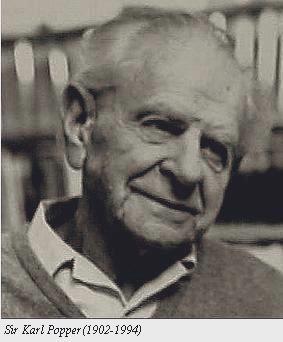
One of the most important thinkers of the 20th Century was the philosopher
Karl Popper. Though he is most recognized as a philosopher of science, I believe his work on the defense of the
Open Society will become more relevant in the immediate future.
Popper labeled himself a "critical-rationalist". My read on this term is that knowledge is the product of reason and sensory input and not merely sensory experience alone (thus the rationalist part of the term) and, that all our reasonings are theory-laden and prone to perspective laden bias (thus the critical portion of the label). Because Popper accepted that all knowledge is theory laden, he rejected the Newtonian idea of pure objective knowledge. From this premise, Popper narrowed the category of knowledge that is actually scientific to that which is
falsifiable. Falsifiability becomes the test as to whether our knowledge can be asserted as scientific.

Critical-rationalism is inherently humble. If one understands that all his knowledge is theory laden, he will be inherently self-critical. This orientation toward one's own knowledge amounts to intellectual humility. One important ramification of Popper's critical understanding of knowledge is his attack on totalitarianism and Marxist historicism. As a result of this application of his theory of knowledge, Popper has a legacy of being a staunch defender of liberty.
Popper's Philosophical Defense of Liberty
Popper explained that a predictive system like Marxism (Marxism claims to predict history), if it is scientific, must be revised when its predictions do not come to pass. Moreover, for a theory to be scientific, it must be possible to construct a test in which if something other than the prediction occurs, the hypothesis is rejected. Marxism, as a system, refuses this type of critic and therefore is non-falsifiable. Popper, therefore, determined that Marxism is a dogma and is inherently non-scientific. This train of thought connects Popper's philosophy of science and his critique of Marxist historicism.
Marxism has the following components that tend toward totalitarianism. First, Marxist historical ideology states explicitly that history is taking a particular path. Marxism makes a prediction. Secondly, as a system of thought, Marxism proves itself to be non-falsifiable because Marxism has resilience against it's own predictive errors. In practice, if a Marxist makes a prediction and the prediction does not come to pass, the Marxist can explain its predictive failure using some caveat of Marxist theory. Thus, Marxism is not scientific because it is not falsifiable, Therefore, Marxism is a dogma.
Such a dogma would be harmless, except that Marxism takes this dogma into the actual realm of politics. Popper's point is that applying a non-falsifiable view of history as the ideological foundation of one's political agenda tends towards totalitarianism. The antidote to this poisonous concoction is liberal democracy. By liberal democracy is meant a democratic system founded on civil rights (e.g. the Bill of Rights).
The conclusion is that to support an open society we must support democratic ideals as opposed to our historicism. All of us bring predictive beliefs about economics and society into the realm of politics, but we must temper our dogma with a commitment to liberty and democracy. In the realm of politics, these commitments must be above all else. For the Christian, this requires a theology which understands the current limited means by which we are allowed to implement the kingdom of God.