It seems a lot of people think alike.
MissionThink
Old Articles from some knucklehead;
How Did We Get Here - Greek and Hebrew Education Models
Discipleship in the Footsteps of Jesus
Conversion to Trustworthy Leadership
There really is a 21st Century Reformation going on.
God Bless,
brad
Tuesday, February 07, 2006


Monday, February 06, 2006

Rivers Cuomo Interview and other stuff
Rivers Cuomo interview with a lot of good talk about songwriting. Weezer isn't on tour as Rivers is finishing his degree at Harvard. I am sure this is all old news to most folk but I was inspired by both of this interview and the bio in Wikapedia.
HT: MoJoey - my bro!!
brad
HT: MoJoey - my bro!!
brad
Saturday, February 04, 2006
Thoughtful and Informative Cosmology Blog
Cosmology Curiosity
Though I have never addressed issues of origins and cosmology on this blog, I was a science teacher in a former life. So if you like history of astronomy and biography of great minds like Hubble and Halley and the like. Here is a good sight.
Though I have never addressed issues of origins and cosmology on this blog, I was a science teacher in a former life. So if you like history of astronomy and biography of great minds like Hubble and Halley and the like. Here is a good sight.
Tuesday, January 31, 2006
Links - Discipleship
I was talking with a pastor friend of mine and he said "Oh, ...that was before the consumerism of the '90 really hit with full steam". I can't remember what we were talking about but that matter of fact statement about the plague of consumerism in the church coming from a seasoned pastor was memorable. It is like "Remember when Kirk Gibson hit that homerun in the world series. Oh yeah and when consumerism became the mindset of the church community." WOW!!! What a challenge!!
In seminary, I had a viseral response to the idea of "Church Growth" and seeker sensitive church, but I never knew why. "Mission think blog" below talks about the problem:
Part 1 of 3
Part 2
Part 3
Another source for what's going on out there in Emerging Land. PurplePastor.com
In seminary, I had a viseral response to the idea of "Church Growth" and seeker sensitive church, but I never knew why. "Mission think blog" below talks about the problem:
Part 1 of 3
Part 2
Part 3
Another source for what's going on out there in Emerging Land. PurplePastor.com
Sunday, January 29, 2006
From Anger to Love - The Pastoral Theology of the Book of Romans
There is much talk today about community and about the church becoming the good news for the sake of the world, and I certainly am a proponent of this community aesthetic as the primary apologetic for the gospel.
One place we see the connection between community building and the Gospel is in the book of Romans. Without going into a big proof of this premise, I contend that Romans was written to the Roman churches to bring unity to the Jewish and Gentile believers in Rome. For example, in the climactic theological sections (Romans 9-11), Paul speaks of the envy and/or pride between Jews and Gentiles and the sovereignty of God in bringing the Gospel to all as He pleases. Looking at Romans in its context we see that all the theology in Romans is written to a pastoral purpose. So, the question is "how does Paul's theology in Romans work to bring about unity?".
The Pastoral Theology of Romans
We begin by understanding that the problem Paul is addressing is a lack of Morally Beautiful (i.e. loving and unified) Community in the Roman churches.
To address this problem, Paul takes the recipients of his letter down a path toward conviction of sin. The conclusion is that the real point of cause of the problem is the heart and that a true follower of God needs not a circumcision that is outward but a "circumcision of the heart".
If we look at Paul's life we can see how this circumcision of the heart happened to Paul. Paul was a righteous person according to the external trappings of the law (Phil 3). But he found himself to be miserable and having one serious character defect - he was covetous or filled with envy (Romans 7). You see, Paul could obey the external elements of the law and created a theology to support this observance as the key to righteousness as a Pharisee. But the law also contains inescapable demands for a pure heart and Paul personally was laid low by the tenth commandment; "Thou shall not covet". Paul was ruthlessly honest and desired to obey all the law. When he was convicted of sin, namely his envy, he was undone. This conviction occurred on the road to Damascus in the presence of Jesus. Wrath was revealed in the gospel. The law was upheld and Jesus provided the answer in His atonement for the wrath of God.
This covetousness turned Paul into a violent offender who opposed true religion. Who did he covet? What was he envious of? How did this make him the chief of sinners? The answer is Paul coveted and envied Steven and the Hellenistic Jews who were externally breaking the traditions of the law. They were law-breakers and yet they found what Paul was looking for. They had shalom. They drove Paul to jealousy. The church had found peace between the nations. The nations, the Hellenistic Jews, were bringing their offerings to the feet of the apostles and the wealth of the nations was flowing into Jerusalem via this supposed heretical Way of Jesus Christ.
Steven, the law-breaker, did not wear phylacteries. He trimmed his beard. He associated with the gentile world. He was ceremonially unclean.
Paul was furious!!! "How could You give him a word of grace? How could you give this rebel against tradition the power of miracles like a prophet? When I saw his face shining like an angel and I realized You gave him, this disloyal Greekish Jew, You gave him shalom and happiness and peace like an angel. We tried our best to take away that peace. We tried to shut him up but he just kept smiling. Our stones could not touch him. It is not fair!!! I labored for you all these years and you never gave me a fatted calf that I could make merry with my friends".
"Oh Paul..why do you persecute me. Is God the God of the Jew alone? Is there but one God of all? Did I not create the heaven and the earth? Is it not my right to grant love and forgiveness and mercy? Behold, I will show you what a great work I will do through you to these very people. I forgive you Paul. This fury you feel is covetousness. You too are a law breaker and I forgive you. Stand up. Go to a man named Annanias and I will show you how you will serve me. I will give you what Steven has if you would only ask. For I am the God of the gentile and the God of the Jew and the Your God and Your savior Jesus, whom you persecute."
So, Paul's heart of anger and rage and envy and jealousy was laid to rest. He was convicted. He was forgiven. He was cleansed and His affections were set free. Through conviction of sin and the offer of forgiveness through the atonement that is in Jesus Christ Paul's heart was quieted and for the first time he understood from the heart what it means to love the Lord your God with all his heart, and all his soul, and all his mind and all his strength.
God Bless,
brad
One place we see the connection between community building and the Gospel is in the book of Romans. Without going into a big proof of this premise, I contend that Romans was written to the Roman churches to bring unity to the Jewish and Gentile believers in Rome. For example, in the climactic theological sections (Romans 9-11), Paul speaks of the envy and/or pride between Jews and Gentiles and the sovereignty of God in bringing the Gospel to all as He pleases. Looking at Romans in its context we see that all the theology in Romans is written to a pastoral purpose. So, the question is "how does Paul's theology in Romans work to bring about unity?".
The Pastoral Theology of Romans
We begin by understanding that the problem Paul is addressing is a lack of Morally Beautiful (i.e. loving and unified) Community in the Roman churches.
To address this problem, Paul takes the recipients of his letter down a path toward conviction of sin. The conclusion is that the real point of cause of the problem is the heart and that a true follower of God needs not a circumcision that is outward but a "circumcision of the heart".
If we look at Paul's life we can see how this circumcision of the heart happened to Paul. Paul was a righteous person according to the external trappings of the law (Phil 3). But he found himself to be miserable and having one serious character defect - he was covetous or filled with envy (Romans 7). You see, Paul could obey the external elements of the law and created a theology to support this observance as the key to righteousness as a Pharisee. But the law also contains inescapable demands for a pure heart and Paul personally was laid low by the tenth commandment; "Thou shall not covet". Paul was ruthlessly honest and desired to obey all the law. When he was convicted of sin, namely his envy, he was undone. This conviction occurred on the road to Damascus in the presence of Jesus. Wrath was revealed in the gospel. The law was upheld and Jesus provided the answer in His atonement for the wrath of God.
This covetousness turned Paul into a violent offender who opposed true religion. Who did he covet? What was he envious of? How did this make him the chief of sinners? The answer is Paul coveted and envied Steven and the Hellenistic Jews who were externally breaking the traditions of the law. They were law-breakers and yet they found what Paul was looking for. They had shalom. They drove Paul to jealousy. The church had found peace between the nations. The nations, the Hellenistic Jews, were bringing their offerings to the feet of the apostles and the wealth of the nations was flowing into Jerusalem via this supposed heretical Way of Jesus Christ.
Steven, the law-breaker, did not wear phylacteries. He trimmed his beard. He associated with the gentile world. He was ceremonially unclean.
Paul was furious!!! "How could You give him a word of grace? How could you give this rebel against tradition the power of miracles like a prophet? When I saw his face shining like an angel and I realized You gave him, this disloyal Greekish Jew, You gave him shalom and happiness and peace like an angel. We tried our best to take away that peace. We tried to shut him up but he just kept smiling. Our stones could not touch him. It is not fair!!! I labored for you all these years and you never gave me a fatted calf that I could make merry with my friends".
"Oh Paul..why do you persecute me. Is God the God of the Jew alone? Is there but one God of all? Did I not create the heaven and the earth? Is it not my right to grant love and forgiveness and mercy? Behold, I will show you what a great work I will do through you to these very people. I forgive you Paul. This fury you feel is covetousness. You too are a law breaker and I forgive you. Stand up. Go to a man named Annanias and I will show you how you will serve me. I will give you what Steven has if you would only ask. For I am the God of the gentile and the God of the Jew and the Your God and Your savior Jesus, whom you persecute."
So, Paul's heart of anger and rage and envy and jealousy was laid to rest. He was convicted. He was forgiven. He was cleansed and His affections were set free. Through conviction of sin and the offer of forgiveness through the atonement that is in Jesus Christ Paul's heart was quieted and for the first time he understood from the heart what it means to love the Lord your God with all his heart, and all his soul, and all his mind and all his strength.
God Bless,
brad
Thursday, January 26, 2006
Anger is the Greatest Enemy
It is common among all of us to hide our inner life from ourselves and others.
The reality is that we are much more spiritually unclean than we realize. The most common and most deadly spiritual disease we are plagued with is anger. There is a process to go through that is very helpful in bringing our sin to our awareness so that we can properly confess and be cleansed.
The answer is the resentment inventory. This process starts with listing everyone you could ever have possibly had a resentment toward. This is a process of journaling every name that comes to your mind. This excercise is very powerful in bringing to our conscious awareness the fact that we are indeed filled with uncleanness. Inside us is dead man’s bones and ultimately some of us our mouths are closed graves but it always conceals the reality of the uncleanness inside of us. The journaling process is the best method of letting this internal uncleanness to the surface.
During the process, if we are rigorously honest with ourselves, we come to realize that our lives are to a greater extent than we previously realized motivated by anger. So we list all the people first. Then we list all the wrongs that have ever occurred. Then we acknowledge what areas of our lives this effects, our social life, our sexual life, our finances, our self-esteem and emotional life, our confidence, our spiritual life etc. Now we are aware of the reality that we are generally pissed off with the world and most every person we have ever met. We take about two weeks sometimes to be thorough. We keep writing until nothing comes to mind.
We have already received an incredible benefit from this process. We have come to see the reality of our wretchedness. We may in many cases feel justified in our anger but if you are sensitive you are aware that this is no way to live and certainly no way to become spiritually healthy. Now comes the Gospel key…
We return to the list and look at it from a completely different perspective. Here is the key…Here in lies the difference between the Christian approach to life and the more therapeutic methods employed by the secular world. We look at the list and are determined to discover “where was I to blame”. In many cases, we realize that our own self-centeredness has brought this problem upon ourselves. In other cases, is it our own self-centeredness that set us up for being hurt. We have an agenda and the rest of the world does not want to follow our agenda and we are hurt. We are rejected because of our own sinfulness. We are controlling and manipulative and people do not like to be around us. We lie and steal and people do not trust us. We are gossips and people tend to be closed to us. We are know it alls and dominate conversation. We are fearful and needy and become a burden to others. This too is self-centeredness. So the world has rejected us but in reality they are under no obligation to submit to our requests and cater to our self-centeredness.
So we begin in ruthless honesty to see our own character defects. No matter what our personality is we are all plagued by some form of self centeredness that we carry with us. It is this universal character trait that we learn to discover and are preparing ourselves to let God remove from us as He performs a circumcision of our hearts.
When we come to own our part in the matter and turn our gaze to our side of the street that we begin to overcome our anger and begin to find real deliverance from our impulsiveness. Here is how discipleship differs from the therapeutic model. The disiciple is after a cleansing and removal of our own sin. Sin is our problem and we are seeking a spiritual solution of power from the Holy Spirit to deliver us from what truly ails us.
The reality is that we are much more spiritually unclean than we realize. The most common and most deadly spiritual disease we are plagued with is anger. There is a process to go through that is very helpful in bringing our sin to our awareness so that we can properly confess and be cleansed.
The answer is the resentment inventory. This process starts with listing everyone you could ever have possibly had a resentment toward. This is a process of journaling every name that comes to your mind. This excercise is very powerful in bringing to our conscious awareness the fact that we are indeed filled with uncleanness. Inside us is dead man’s bones and ultimately some of us our mouths are closed graves but it always conceals the reality of the uncleanness inside of us. The journaling process is the best method of letting this internal uncleanness to the surface.
During the process, if we are rigorously honest with ourselves, we come to realize that our lives are to a greater extent than we previously realized motivated by anger. So we list all the people first. Then we list all the wrongs that have ever occurred. Then we acknowledge what areas of our lives this effects, our social life, our sexual life, our finances, our self-esteem and emotional life, our confidence, our spiritual life etc. Now we are aware of the reality that we are generally pissed off with the world and most every person we have ever met. We take about two weeks sometimes to be thorough. We keep writing until nothing comes to mind.
We have already received an incredible benefit from this process. We have come to see the reality of our wretchedness. We may in many cases feel justified in our anger but if you are sensitive you are aware that this is no way to live and certainly no way to become spiritually healthy. Now comes the Gospel key…
We return to the list and look at it from a completely different perspective. Here is the key…Here in lies the difference between the Christian approach to life and the more therapeutic methods employed by the secular world. We look at the list and are determined to discover “where was I to blame”. In many cases, we realize that our own self-centeredness has brought this problem upon ourselves. In other cases, is it our own self-centeredness that set us up for being hurt. We have an agenda and the rest of the world does not want to follow our agenda and we are hurt. We are rejected because of our own sinfulness. We are controlling and manipulative and people do not like to be around us. We lie and steal and people do not trust us. We are gossips and people tend to be closed to us. We are know it alls and dominate conversation. We are fearful and needy and become a burden to others. This too is self-centeredness. So the world has rejected us but in reality they are under no obligation to submit to our requests and cater to our self-centeredness.
So we begin in ruthless honesty to see our own character defects. No matter what our personality is we are all plagued by some form of self centeredness that we carry with us. It is this universal character trait that we learn to discover and are preparing ourselves to let God remove from us as He performs a circumcision of our hearts.
When we come to own our part in the matter and turn our gaze to our side of the street that we begin to overcome our anger and begin to find real deliverance from our impulsiveness. Here is how discipleship differs from the therapeutic model. The disiciple is after a cleansing and removal of our own sin. Sin is our problem and we are seeking a spiritual solution of power from the Holy Spirit to deliver us from what truly ails us.
Wednesday, January 25, 2006
Tuesday, January 24, 2006
A Portrait of the Emerging Pastor
As a pastor, and a child of the streets of “Los Angeles”, I find a cultural clash occurring between various cultural expectations of the pastor as a role model in the evangelical community. There is the emerging pastor who maybe dresses down and expresses himself in a very accessible and common manner. The pastor is the normal Joe. The primary value is authenticity and his demeanor is intended to contradict the stereotype of the "good looking guy who has it all together" image of a by-gone era. To the emerging pastor, the key is to put your worst foot forward as opposed to your best foot. To show weakness and to use yourself as an example of weakness and spiritual neediness is central to the meta-message of the emerging pastor's approach to his place as a role model.
In fact, the key principle is that there is no difference between the emerging pastor’s public and private persona. This principle is intended to teach that we ought not to live in fear, but, instead, the church is to be a safe community where there are no hidden rules and hidden agendas. The church is to be first and foremost a “no condemnation zone”. The church is the safest place on earth to be open and honest about your struggles with sin.
Pastors are called to be safe to the most hurting people in our society. The addict and the deviant must know that this man understands the self loathing and the powerlessness one feels when they carry with them a history of shameful deeds. A polo shirt or a suit and tie doesn’t make the outcast feel safe and at home.
Salt and Light – Being Distinctive
It is an interesting thing that the emerging pastor is often criticized for being more concerned with Pop culture than being distinct and holy. But this is a misunderstanding of the values of the emerging community leaders. The meta-message behind being hip is not “look at me I’m hip” but that we do not believe that cultural distinctives are good barometers of heart holiness. Being distinct is not so much about cigarettes and secular music as generosity and hospitality. The emerging pastor has Weezer on his iPod and a homeless family in his living room. By contrast, the old model tended to maintain the home as a sanctuary and to consider keeping in step with Pop culture to be a sign of worldliness. In the new paradigm, being culturally hip is simply a way of saying that it is not cultural distinctiveness that is the proper barometer of holiness but honesty, love, compassion, and a mild temperament. Being culturally aware is simply a way of showing that the old standards are superficial. The world is in need not of the forms of religion but the power that can transform the affections.
To the uninitiated, this new set of values is easily mis-interpreted. The old wineskin cannot hold the new wine. When the two are combined (the old wineskin with the new wine) much confusion and misunderstanding can ensue. What is needed is for the emerging pastor and the old paradigm to find a place of conversation and dialogue. All parties must learn to submit our preferences at the feet of the Missional purposes of the God of Love and become a multi-cultural expression of love and tolerance to a world caught in the grips of fear and guilt and all the lonliness that comes from a life of hiding behind the mask of a self-imposed prison of false dignity.
God Bless,
brad
emerging;Church;Christianity;Jesus;Emerging Church;Ministry;
In fact, the key principle is that there is no difference between the emerging pastor’s public and private persona. This principle is intended to teach that we ought not to live in fear, but, instead, the church is to be a safe community where there are no hidden rules and hidden agendas. The church is to be first and foremost a “no condemnation zone”. The church is the safest place on earth to be open and honest about your struggles with sin.
Pastors are called to be safe to the most hurting people in our society. The addict and the deviant must know that this man understands the self loathing and the powerlessness one feels when they carry with them a history of shameful deeds. A polo shirt or a suit and tie doesn’t make the outcast feel safe and at home.
Salt and Light – Being Distinctive
It is an interesting thing that the emerging pastor is often criticized for being more concerned with Pop culture than being distinct and holy. But this is a misunderstanding of the values of the emerging community leaders. The meta-message behind being hip is not “look at me I’m hip” but that we do not believe that cultural distinctives are good barometers of heart holiness. Being distinct is not so much about cigarettes and secular music as generosity and hospitality. The emerging pastor has Weezer on his iPod and a homeless family in his living room. By contrast, the old model tended to maintain the home as a sanctuary and to consider keeping in step with Pop culture to be a sign of worldliness. In the new paradigm, being culturally hip is simply a way of saying that it is not cultural distinctiveness that is the proper barometer of holiness but honesty, love, compassion, and a mild temperament. Being culturally aware is simply a way of showing that the old standards are superficial. The world is in need not of the forms of religion but the power that can transform the affections.
To the uninitiated, this new set of values is easily mis-interpreted. The old wineskin cannot hold the new wine. When the two are combined (the old wineskin with the new wine) much confusion and misunderstanding can ensue. What is needed is for the emerging pastor and the old paradigm to find a place of conversation and dialogue. All parties must learn to submit our preferences at the feet of the Missional purposes of the God of Love and become a multi-cultural expression of love and tolerance to a world caught in the grips of fear and guilt and all the lonliness that comes from a life of hiding behind the mask of a self-imposed prison of false dignity.
God Bless,
brad
emerging;Church;Christianity;Jesus;Emerging Church;Ministry;
Saturday, January 21, 2006
Blogging and Stuff - Best Music 2005
Lately I haven't been blogging. I don't think I have been in a good enough place to blog. I need to press back into it...BUT

I do have some links...Top 10 music I listened to in 2005
1. Matisyahu - King Without A Crown
Matisyahu is the top pick for enlightening music in 2005.
He is in the wonderful ecstatic tradition that has yet to become reality.
Maybe, such a dream will become a reality and Matisyahu will blaze the trail.

2. Steel Pulse - Chant a Psalm
This is old school reggae at it's best. I wish I could. Ok I will...click here.
Pure joyful celebration...These guys may be heretics but they understand the kingdom...Go figure??
3. System of a Down - Hypnotize
If my son grows up to play guitar like DARON MALAKIAN I will be officially justified.
4. U2 - Miracle Drug
Bono for man of the year. This song we have reviewed here before. It is Bono's dream for all of to come together in Jesus name and find a cure to various diseases that plague the globe. No one leverages celebrity for good like Bono.
5. Monk/Train - Nutty
6. Weezer - Perfect Situation
I listened to the Make Believe album with MoJoey on the way into town from Palm Springs this morning and I could not for the life of me understand why this album didn't get great reviews.
7. Matt Redman - Nothing But the Blood
8. Switchfoot - Stars
Best DVD here - The Violet Burning - click here WOW. Why isn't The Violet Burning as big as U2?
God Bless,
brad
I do have some links...Top 10 music I listened to in 2005
1. Matisyahu - King Without A Crown
Matisyahu is the top pick for enlightening music in 2005.
He is in the wonderful ecstatic tradition that has yet to become reality.
Maybe, such a dream will become a reality and Matisyahu will blaze the trail.
2. Steel Pulse - Chant a Psalm
This is old school reggae at it's best. I wish I could. Ok I will...click here.
Pure joyful celebration...These guys may be heretics but they understand the kingdom...Go figure??
3. System of a Down - Hypnotize
If my son grows up to play guitar like DARON MALAKIAN I will be officially justified.
4. U2 - Miracle Drug
Bono for man of the year. This song we have reviewed here before. It is Bono's dream for all of to come together in Jesus name and find a cure to various diseases that plague the globe. No one leverages celebrity for good like Bono.
5. Monk/Train - Nutty
6. Weezer - Perfect Situation
I listened to the Make Believe album with MoJoey on the way into town from Palm Springs this morning and I could not for the life of me understand why this album didn't get great reviews.
7. Matt Redman - Nothing But the Blood
8. Switchfoot - Stars
Best DVD here - The Violet Burning - click here WOW. Why isn't The Violet Burning as big as U2?
God Bless,
brad
Tuesday, January 03, 2006
2005 Christmas Sermon - Anna and Simeon
For sermon audio click here (2005 Christmas - Anna and Simeon)
For Podcast subscription - cut and paste this url(http://reformation.typepad.com/sermons/rss.xml ) into subscription in iTunes or Media Player
Or use feedburner: http://feeds.feedburner.com/typepad/uSRJ
God Bless,
brad
For Podcast subscription - cut and paste this url(http://reformation.typepad.com/sermons/rss.xml ) into subscription in iTunes or Media Player
Or use feedburner: http://feeds.feedburner.com/typepad/uSRJ
God Bless,
brad
Wednesday, December 28, 2005
Bono: In Conversation with Michka Assayas
Bono interview (HT Smart Christian and PaperCut Theology) This is pretty old news but it is quite good. It seems Bono is willing to cut straight to the chase on things theoogical. I think this point is so good about the difference between Karma and Grace. In counsiling myself and other total misfit toys like me, Karma just doesn't help much. The cycle of Karma has been broken by grace and nutballs like us got hope.
Q&A excerpted from the new book "Bono: In Conversation with Michka Assayas" by Michka Assayas.
Assayas: I think I am beginning to understand religion because I have started acting and thinking like a father. What do you make of that?
Bono: Yes, I think that's normal. It's a mind-blowing concept that the God who created the universe might be looking for company, a real relationship with people, but the thing that keeps me on my knees is the difference between Grace and Karma.
Assayas: I haven't heard you talk about that.
Bono: I really believe we've moved out of the realm of Karma into one of Grace.
Assayas: Well, that doesn't make it clearer for me.
Bono: You see, at the center of all religions is the idea of Karma. You know, what you put out comes back to you: an eye for an eye, a tooth for a tooth, or in physics—in physical laws—every action is met by an equal or an opposite one. It's clear to me that Karma is at the very heart of the universe. I'm absolutely sure of it. And yet, along comes this idea called Grace to upend all that "as you reap, so you will sow" stuff. Grace defies reason and logic. Love interrupts, if you like, the consequences of your actions, which in my case is very good news indeed, because I've done a lot of stupid stuff.
Assayas: I'd be interested to hear that.
Bono: That's between me and God. But I'd be in big trouble if Karma was going to finally be my judge. I'd be in deep s---. It doesn't excuse my mistakes, but I'm holding out for Grace. I'm holding out that Jesus took my sins onto the Cross, because I know who I am, and I hope I don't have to depend on my own religiosity.
Assayas: The Son of God who takes away the sins of the world. I wish I could believe in that.
Bono: But I love the idea of the Sacrificial Lamb. I love the idea that God says: Look, you cretins, there are certain results to the way we are, to selfishness, and there's a mortality as part of your very sinful nature, and, let's face it, you're not living a very good life, are you? There are consequences to actions. The point of the death of Christ is that Christ took on the sins of the world, so that what we put out did not come back to us, and that our sinful nature does not reap the obvious death. That's the point. It should keep us humbled… . It's not our own good works that get us through the gates of heaven.
Q&A excerpted from the new book "Bono: In Conversation with Michka Assayas" by Michka Assayas.
Assayas: I think I am beginning to understand religion because I have started acting and thinking like a father. What do you make of that?
Bono: Yes, I think that's normal. It's a mind-blowing concept that the God who created the universe might be looking for company, a real relationship with people, but the thing that keeps me on my knees is the difference between Grace and Karma.
Assayas: I haven't heard you talk about that.
Bono: I really believe we've moved out of the realm of Karma into one of Grace.
Assayas: Well, that doesn't make it clearer for me.
Bono: You see, at the center of all religions is the idea of Karma. You know, what you put out comes back to you: an eye for an eye, a tooth for a tooth, or in physics—in physical laws—every action is met by an equal or an opposite one. It's clear to me that Karma is at the very heart of the universe. I'm absolutely sure of it. And yet, along comes this idea called Grace to upend all that "as you reap, so you will sow" stuff. Grace defies reason and logic. Love interrupts, if you like, the consequences of your actions, which in my case is very good news indeed, because I've done a lot of stupid stuff.
Assayas: I'd be interested to hear that.
Bono: That's between me and God. But I'd be in big trouble if Karma was going to finally be my judge. I'd be in deep s---. It doesn't excuse my mistakes, but I'm holding out for Grace. I'm holding out that Jesus took my sins onto the Cross, because I know who I am, and I hope I don't have to depend on my own religiosity.
Assayas: The Son of God who takes away the sins of the world. I wish I could believe in that.
Bono: But I love the idea of the Sacrificial Lamb. I love the idea that God says: Look, you cretins, there are certain results to the way we are, to selfishness, and there's a mortality as part of your very sinful nature, and, let's face it, you're not living a very good life, are you? There are consequences to actions. The point of the death of Christ is that Christ took on the sins of the world, so that what we put out did not come back to us, and that our sinful nature does not reap the obvious death. That's the point. It should keep us humbled… . It's not our own good works that get us through the gates of heaven.
Saturday, December 24, 2005
Podcast - Sermon 2 - Meekness
My only theme this year it seems. Subscribe to podcasts here. Cut and paste this url:
http://reformation.typepad.com/sermons/rss.xml
into your podcast subscriptions in your media player (iTunes etc).
Or this one, I think this one works too???..
http://feeds.feedburner.com/typepad/uSRJ
God Bless,
brad
http://reformation.typepad.com/sermons/rss.xml
into your podcast subscriptions in your media player (iTunes etc).
Or this one, I think this one works too???..
http://feeds.feedburner.com/typepad/uSRJ
God Bless,
brad
Tuesday, December 20, 2005
Christmas - A Time for Receiving
Tod Bolsinger recent post on "God is better than Santa" got me reflecting a bit on my personal story. Tod's post is saying that if we see our relationship with God as a matter of giving instead of receiving then we end up thinking we deserve or have earned God's grace. But instead, we it is most helpful to see Christmas as about receiving and in fact all of spirituality about receiving. This is a profound truth that sometimes is counter intuitive and is contrary to what our emotions (false humility) actually is telling us.
My Personal Story
I remember once I was at a retreat, and we were in the ministry time and a couple came up and wanted to pray for me. They said to put my hands out like I was receiving a gift. I was very awkward. I distinctly remember feeling that I am not to receive from God but give to Him. I had a "the lesser serves the greater" kind of instinct. Anyway, as they prayed for me, I began to weep, but the funny thing was I couldn't feel any thing. They asked what are you "feeling"? I actually said out loud, "I don't feel any thing?" as I wept uncontrollably. Well, the next few years completely changed my personality. (and you thought I am a basket case now..)..Our spiritual transformation all hinges on the idea of changing from being on the giving end or the receiving end with respect to spirituality.
God Bless,
brad
Tags:Christmas; religion
My Personal Story
I remember once I was at a retreat, and we were in the ministry time and a couple came up and wanted to pray for me. They said to put my hands out like I was receiving a gift. I was very awkward. I distinctly remember feeling that I am not to receive from God but give to Him. I had a "the lesser serves the greater" kind of instinct. Anyway, as they prayed for me, I began to weep, but the funny thing was I couldn't feel any thing. They asked what are you "feeling"? I actually said out loud, "I don't feel any thing?" as I wept uncontrollably. Well, the next few years completely changed my personality. (and you thought I am a basket case now..)..Our spiritual transformation all hinges on the idea of changing from being on the giving end or the receiving end with respect to spirituality.
God Bless,
brad
Tags:Christmas; religion
Monday, December 19, 2005
Podcast - Sermons
It is official. I have started a podcast. I think our little church has something to say to the body at large and so I have started a sermons podcast.
To subscribe cut and paste this URL (http://reformation.typepad.com/sermons/rss.xml) into your subscriptions in iTunes. If you don't use iTunes I imagine it is very similar. Basically this url (http://reformation.typepad.com/sermons/rss.xml) is the rss and your media player will dowload any updates to this feed. I plan on posting two sermons a week or at least one.
God Bless,
brad
Technotati tags: podcast; Podcasts
To subscribe cut and paste this URL (http://reformation.typepad.com/sermons/rss.xml) into your subscriptions in iTunes. If you don't use iTunes I imagine it is very similar. Basically this url (http://reformation.typepad.com/sermons/rss.xml) is the rss and your media player will dowload any updates to this feed. I plan on posting two sermons a week or at least one.
God Bless,
brad
Technotati tags: podcast; Podcasts
Thursday, December 15, 2005
The Most Important Part of Prayer
The Most Important part of Prayer
When our Lord taught us to pray, He outlined a specific prayer, a quite simple prayer, to keep our priorities and attitude properly aligned in our prayer life. What can we learn about prayer from our Lord’s teaching on prayer.
1. The foundation of prayer is the orientation of our life toward God’s rule and reign.
Jesus taught us to pray by saying, "Our father in heaven hallowed by Your name. Your kingdom come your will be done on earth as it is in heaven." This prayer is entirely about aligning ourselves with the Sovereign Lordship of God and submitting our lives to His agenda. Here is the key to our spiritual lives and in fact our peace and happiness. The purpose of prayer is first and foremost our own repentance. The key to daily living is to turn from self-centeredness to God-centeredness.
How to achieve this alignment of our wills!
It is important to know that such alignment of our wills does not come with the words of our prayer but with the actual act of alignment. Jesus Himself says that it is not the words that matter. The Father already knows what we need. Prayer is a spiritual discipline to condition our person in meekness and worship. A key to this exercise is to realize that the opposite of self-centeredness is not 'non-self-centeredness" but God centeredness. To rest in the place of God-centeredness requires spiritual vision. What we are seeking in this exercise is a right view of God. Such a view of God is dependent on the Holy Spirit.
So the second point I would make is that such an orientation is not about words but about a view of God that brings what the bible calls “the fear of the Lord”. This fear of the Lord is a joyful place of acknowledging and seeing in our person the greatness of God and accepting His perfections.
The possible content of such a meditation is almost infinite. We might think of His wisdom in sending Jesus that He might be both the “just and the justifier of the one who believes in Jesus. Or His love in sending Jesus to make a way for our abiding forgiveness. We might thank Him for our lives and our experience of life. We might be thankful for His faithfulness in our lives. We might read a healing story from the life of Jesus and simply meditate on God’s compassion. We might praise for being a God of justice and mercy. BUT most importantly, we must be aware that the Holy Spirit is working with us to help us to worship God and to see His excellencies.
The Acceptance of God’s Will
I prefer the term acceptance to the term surrender when it comes to the orientation of the will. So often we stumble over the term surrender as in “total surrender”. We always will ask ourselves “Am I totally surrendered?” if we believe that surrender is a doorway to the blessed life, but acceptance is a more precise description of what is really happening.
“Lord, what ever happens in my life, whether good or bad, health or sickness, favor or persecution, all of this I accept as coming from Your hand and an opportunity for Your kingdom to come”.
We accept two essential realities in life. We accept all our circumstances which come to us. We accept that significant people around us are spiritually sick. We desire their spiritual healing and desire their spiritual maturity but first we accept them just as they are. We are absolutely tolerant of all people. Here is our peace.
Secondly, we accept God’s declared will, His word. We accept the word revealed in Jesus to love unconditionally. In this acceptance, we have come in alignment with God’s providence and His commands. We see trials as opportunities and difficult people as the most in need of our acceptance and love. We see difficulties as the moment when we can Glorify God and show His love.
This alignment of our wills is something we do more than daily but it is helpful to formally do as a spiritual discipline at least morning and night if we expect to abide in Christ and His word and thereby bear fruit to the Glory of the Father. The goal is to learn to walk during our day in these attitudes with prayer being a focused and directed time of orientation.
God Bless,
brad
When our Lord taught us to pray, He outlined a specific prayer, a quite simple prayer, to keep our priorities and attitude properly aligned in our prayer life. What can we learn about prayer from our Lord’s teaching on prayer.
1. The foundation of prayer is the orientation of our life toward God’s rule and reign.
Jesus taught us to pray by saying, "Our father in heaven hallowed by Your name. Your kingdom come your will be done on earth as it is in heaven." This prayer is entirely about aligning ourselves with the Sovereign Lordship of God and submitting our lives to His agenda. Here is the key to our spiritual lives and in fact our peace and happiness. The purpose of prayer is first and foremost our own repentance. The key to daily living is to turn from self-centeredness to God-centeredness.
How to achieve this alignment of our wills!
It is important to know that such alignment of our wills does not come with the words of our prayer but with the actual act of alignment. Jesus Himself says that it is not the words that matter. The Father already knows what we need. Prayer is a spiritual discipline to condition our person in meekness and worship. A key to this exercise is to realize that the opposite of self-centeredness is not 'non-self-centeredness" but God centeredness. To rest in the place of God-centeredness requires spiritual vision. What we are seeking in this exercise is a right view of God. Such a view of God is dependent on the Holy Spirit.
So the second point I would make is that such an orientation is not about words but about a view of God that brings what the bible calls “the fear of the Lord”. This fear of the Lord is a joyful place of acknowledging and seeing in our person the greatness of God and accepting His perfections.
The possible content of such a meditation is almost infinite. We might think of His wisdom in sending Jesus that He might be both the “just and the justifier of the one who believes in Jesus. Or His love in sending Jesus to make a way for our abiding forgiveness. We might thank Him for our lives and our experience of life. We might be thankful for His faithfulness in our lives. We might read a healing story from the life of Jesus and simply meditate on God’s compassion. We might praise for being a God of justice and mercy. BUT most importantly, we must be aware that the Holy Spirit is working with us to help us to worship God and to see His excellencies.
The Acceptance of God’s Will
I prefer the term acceptance to the term surrender when it comes to the orientation of the will. So often we stumble over the term surrender as in “total surrender”. We always will ask ourselves “Am I totally surrendered?” if we believe that surrender is a doorway to the blessed life, but acceptance is a more precise description of what is really happening.
“Lord, what ever happens in my life, whether good or bad, health or sickness, favor or persecution, all of this I accept as coming from Your hand and an opportunity for Your kingdom to come”.
We accept two essential realities in life. We accept all our circumstances which come to us. We accept that significant people around us are spiritually sick. We desire their spiritual healing and desire their spiritual maturity but first we accept them just as they are. We are absolutely tolerant of all people. Here is our peace.
Secondly, we accept God’s declared will, His word. We accept the word revealed in Jesus to love unconditionally. In this acceptance, we have come in alignment with God’s providence and His commands. We see trials as opportunities and difficult people as the most in need of our acceptance and love. We see difficulties as the moment when we can Glorify God and show His love.
This alignment of our wills is something we do more than daily but it is helpful to formally do as a spiritual discipline at least morning and night if we expect to abide in Christ and His word and thereby bear fruit to the Glory of the Father. The goal is to learn to walk during our day in these attitudes with prayer being a focused and directed time of orientation.
God Bless,
brad
Tuesday, December 13, 2005
Prayer Tools - The Lord's Prayer - Part 1
Adrian Warnock introduced a topic on prayer. He is asking "Can you suggest how to keep a prayer journal?". Well, this is something I have been doing and learning for over 10 years and here is the best method I know.
I teach prayer through the Lord's prayer and I use these sheets. The goal is to pray morning and evening. Also, it is helpful to NOT BE HEROIC. What I mean by that is that when I was single and very charismatic, we tended to think you had to have some great "breakthrough" every day. I find this super-prayer warrior mwentality to not be helpful. So simply use these sheets to orient your heart in the surrender and to journal a few simple requests. The key is that our hearts are centered on God and His will. The "meekness, mercy, purity, peacemaking" part under "Thy kingdom come" is our way of keeping our hearts in the ways of the kingdom as taught in the Sermon on the Mount. So that is it for today. I will try to elaborate as the week progresses. I also will link the actual word docs too.
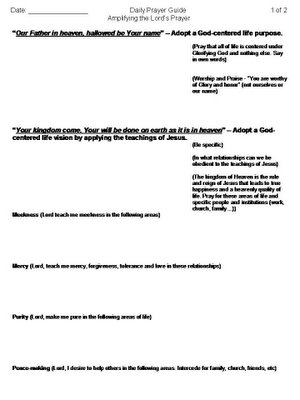
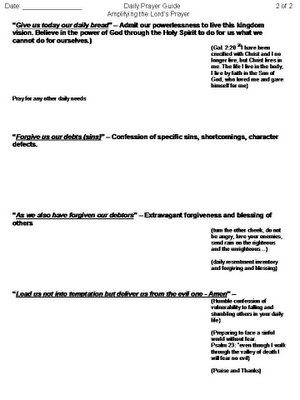
Well, that is the best I can do for now....I will try and clear this up...I hope this is helpful.
God Bless, brad
I teach prayer through the Lord's prayer and I use these sheets. The goal is to pray morning and evening. Also, it is helpful to NOT BE HEROIC. What I mean by that is that when I was single and very charismatic, we tended to think you had to have some great "breakthrough" every day. I find this super-prayer warrior mwentality to not be helpful. So simply use these sheets to orient your heart in the surrender and to journal a few simple requests. The key is that our hearts are centered on God and His will. The "meekness, mercy, purity, peacemaking" part under "Thy kingdom come" is our way of keeping our hearts in the ways of the kingdom as taught in the Sermon on the Mount. So that is it for today. I will try to elaborate as the week progresses. I also will link the actual word docs too.

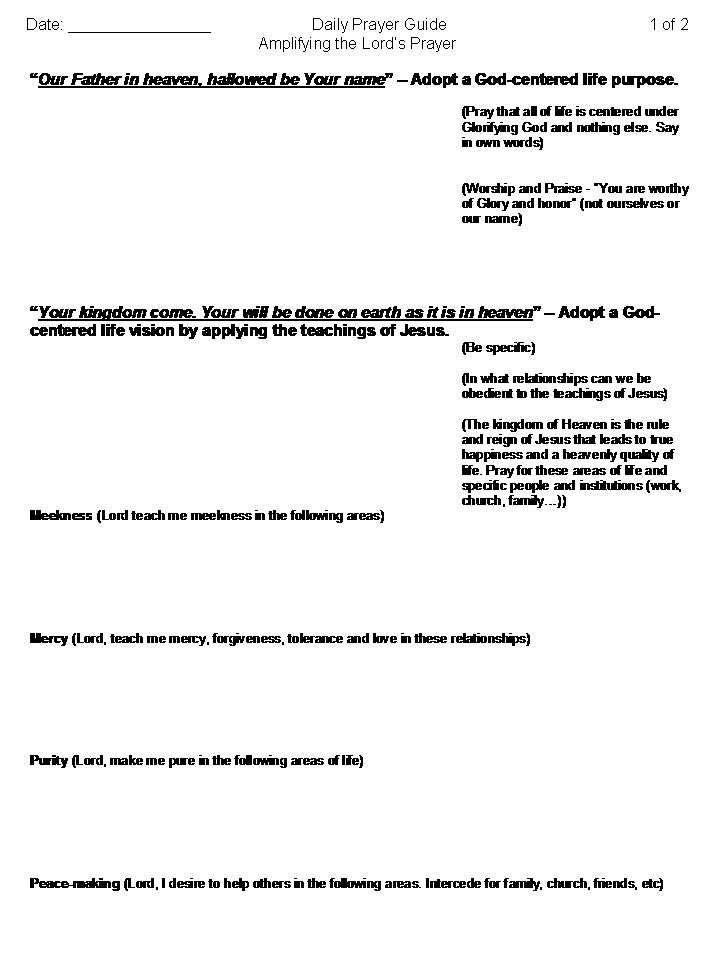
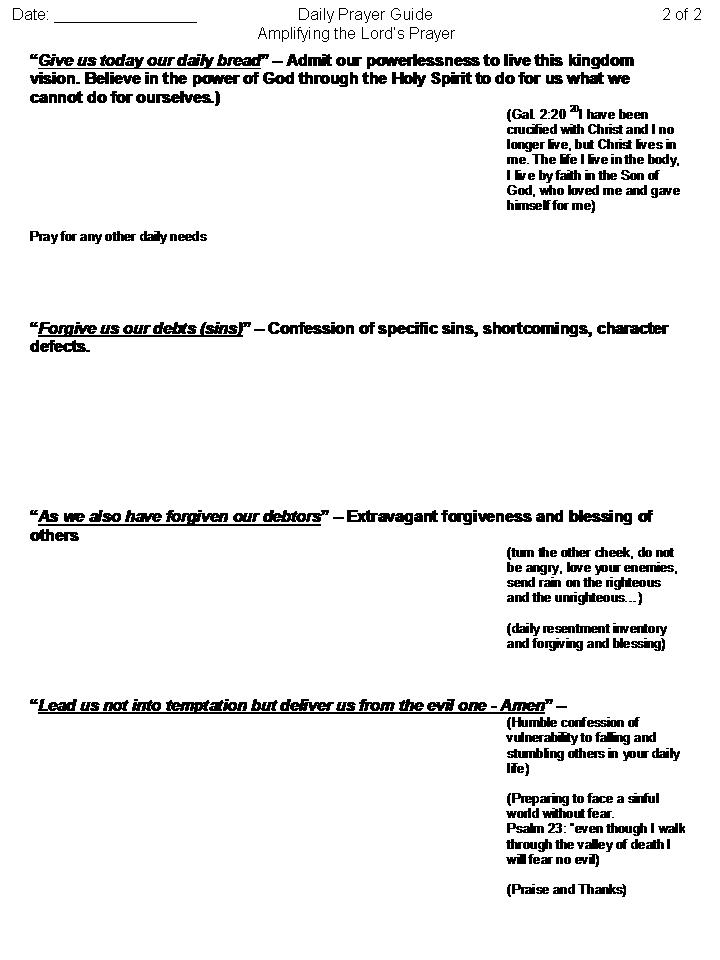
Well, that is the best I can do for now....I will try and clear this up...I hope this is helpful.
God Bless, brad
Saturday, December 03, 2005
The SBC-IMB and Open Letter from Wade Burleson
See this post for a little bit on the Southern Baptist International Mission Board on Tongues and Baptism from a trustee on the IMB...
Update: Here is another open letter from an insider. Also, I am thinking of starting a Baptist Blogs blogroll. This denomination seems to have some real mover shaker bloggers.
This is really a big deal and it opens up all kinds of polity issues. I orginally wanted to make comments but realized this issue is very complicated. A discussion on the role of democracy in the church, I think is valid. The role of such boards and committees in denominations and local chuches is vital to the mission of the church. Who should be making such HUGE policy decisions?
At the local church, such similar issues play out with similar weight for the local church. This instance in the SBC-IMB is larger in scope and certainly graver in its ramifications for unity and the witness of the universal church.
Prayerfully,
brad
Update: Here is another open letter from an insider. Also, I am thinking of starting a Baptist Blogs blogroll. This denomination seems to have some real mover shaker bloggers.
This is really a big deal and it opens up all kinds of polity issues. I orginally wanted to make comments but realized this issue is very complicated. A discussion on the role of democracy in the church, I think is valid. The role of such boards and committees in denominations and local chuches is vital to the mission of the church. Who should be making such HUGE policy decisions?
At the local church, such similar issues play out with similar weight for the local church. This instance in the SBC-IMB is larger in scope and certainly graver in its ramifications for unity and the witness of the universal church.
Prayerfully,
brad
Friday, December 02, 2005
Church Polity - Ecclesiology by a Novice
Update the tongues and baptism issue is SBC and is a decision by the International Missionary Board of the SBC (IMB). Also, here is a post from Missional Baptist on the issues. Lots of comments.
Adrian posts that the Baptists have banned all missionaries who speak in tongues. My question is does anyone know much about Baptist polity. Is this the big successful pastors who are pushing this? I doubt it. Is it theologians and seminary professors? Or is it bureaucrats? Is this principles or politics?
Also here is a great article on the conversion of Anne Rice. Very good article.
Adrian posts that the Baptists have banned all missionaries who speak in tongues. My question is does anyone know much about Baptist polity. Is this the big successful pastors who are pushing this? I doubt it. Is it theologians and seminary professors? Or is it bureaucrats? Is this principles or politics?
Also here is a great article on the conversion of Anne Rice. Very good article.
Thursday, December 01, 2005
Reformed and Charismatic and The Central Role of Discipleship
Updates for typos and errors:
Two things are really difficult pastorally. One is making charismatics out of reformed believers, and the other is reforming charismatics. These two groups are so far apart in temperament and priorities that one is tempted to say that the two shall never meet. But with God, all things are possible.
Paul’s Ministry Experience
When we look at the New Testament churches, we realize that no church is perfect. Paul had real problems in almost all the churches he started. The Galatians had problems with legalism that almost completely undermined the true gospel. The Colossians had problems with syncretism and mysticism, and of course the Corinthian church, which Paul spent more time than with any other church, had serious divisions around rhetorical excellence and spiritual excess.
The Corinthian problem was twofold:
1. They idolized those preachers who had the best rhetorical skills.
2. They judged one another’s spirituality by how powerful an individual’s spiritual gifting was. The one who spoke in tongues the loudest and the weirdest was considered more spiritual.
What I would like to emphasize is how Paul dealt with these problems.
Paul Did Not Outlaw Spiritual Gifts
As a pastor, this Cessationist solution has been taken by many to the problems of charismatic excess. This is a very good defensive position to take. The problem is that this solution only deals with the symptoms. Paul was a better theologian and a better pastor than many of us and so he pointed out the real root cause of the problem.
Paul’s solution is to address the root cause of egomania by teaching on agape love.
The Root Cause of the problem of Charismania is egomania. Therefore, the solution to the problem is discipleship according to the principles of Jesus Christ, our Lord.
Paul says to the Corinthians, “Are you not worldly since you create these parties and divisions based on the charisma of your leaders?” The problem Paul is addressing is worldliness as in the idolatry of men. We are not entertainers!!!
With respect to excessive use of spiritual gifts in public, Paul knows that the root cause is self-centeredness and, therefore, he teaches the people about love. Paul is saying, “You are using spiritual gifts in order to display before others that you are spiritual. This is not the purpose of God’s Spirit and His gifts. The purpose of the gifts is love. If you grow and learn love, then you will use the gifts of God, healing, prophecy, tongues and interpretation, in such a way that you glorify God. Love is patient and kind. It does not boast or act unbecoming. It does not seek its own. Love never fails”.
The Root Cause of the Problem is Self-Centeredness and the Solution is Discipleship.
If we look at Paul’s biblical solution to the problem of fanatical excess, we see that Cessationism is not the proper solution.
A Note to Charismatics
Charismatics need to examine their ministries and the motive of the heart. We need to admit that there really is a problem of fanaticism and egomania in the charismatic churches. The central pastoral need in all the churches is discipleship. The central principle of discipleship is love and the place to learn the ways of love is the Sermon on the Mount and the teachings of Jesus.
The presence of spiritual excess and fanaticism shows a lack of discipleship in the principles of Jesus. Jesus teaches meekness. Meekness is a great anecdote to self-centered fanaticism which is so apparent in the charismatic churches.
A Note to Conservatives
On the other hand, conservatives and Cessationists need to realize that to disallow prophecy and tongues in the church is not a true solution to the problem. This solution leads to a Christianity without power and without experience of God’s intimate care and concern for people. God knows us intimately and He speak to us intimately. God knows our pains and he shows compassion and heals us. Prophecy and healing are central to the presence of the kingdom of God in this age of grace.
As we seek a full expression of our faith, the place to start is to lay a solid foundation of discipleship. Teach the ways of Jesus Christ that progressively matures the believers in love and self-denial. From this foundation of discipleship the expression of the power of the Holy Spirit will marry both the heart of God and the hand of God. This corporate expression of love and compassion is the place of God-centered God-glorifying Kingdom Christianity.
God Bless,
brad
Two things are really difficult pastorally. One is making charismatics out of reformed believers, and the other is reforming charismatics. These two groups are so far apart in temperament and priorities that one is tempted to say that the two shall never meet. But with God, all things are possible.
Paul’s Ministry Experience
When we look at the New Testament churches, we realize that no church is perfect. Paul had real problems in almost all the churches he started. The Galatians had problems with legalism that almost completely undermined the true gospel. The Colossians had problems with syncretism and mysticism, and of course the Corinthian church, which Paul spent more time than with any other church, had serious divisions around rhetorical excellence and spiritual excess.
The Corinthian problem was twofold:
1. They idolized those preachers who had the best rhetorical skills.
2. They judged one another’s spirituality by how powerful an individual’s spiritual gifting was. The one who spoke in tongues the loudest and the weirdest was considered more spiritual.
What I would like to emphasize is how Paul dealt with these problems.
Paul Did Not Outlaw Spiritual Gifts
As a pastor, this Cessationist solution has been taken by many to the problems of charismatic excess. This is a very good defensive position to take. The problem is that this solution only deals with the symptoms. Paul was a better theologian and a better pastor than many of us and so he pointed out the real root cause of the problem.
Paul’s solution is to address the root cause of egomania by teaching on agape love.
The Root Cause of the problem of Charismania is egomania. Therefore, the solution to the problem is discipleship according to the principles of Jesus Christ, our Lord.
Paul says to the Corinthians, “Are you not worldly since you create these parties and divisions based on the charisma of your leaders?” The problem Paul is addressing is worldliness as in the idolatry of men. We are not entertainers!!!
With respect to excessive use of spiritual gifts in public, Paul knows that the root cause is self-centeredness and, therefore, he teaches the people about love. Paul is saying, “You are using spiritual gifts in order to display before others that you are spiritual. This is not the purpose of God’s Spirit and His gifts. The purpose of the gifts is love. If you grow and learn love, then you will use the gifts of God, healing, prophecy, tongues and interpretation, in such a way that you glorify God. Love is patient and kind. It does not boast or act unbecoming. It does not seek its own. Love never fails”.
The Root Cause of the Problem is Self-Centeredness and the Solution is Discipleship.
If we look at Paul’s biblical solution to the problem of fanatical excess, we see that Cessationism is not the proper solution.
A Note to Charismatics
Charismatics need to examine their ministries and the motive of the heart. We need to admit that there really is a problem of fanaticism and egomania in the charismatic churches. The central pastoral need in all the churches is discipleship. The central principle of discipleship is love and the place to learn the ways of love is the Sermon on the Mount and the teachings of Jesus.
The presence of spiritual excess and fanaticism shows a lack of discipleship in the principles of Jesus. Jesus teaches meekness. Meekness is a great anecdote to self-centered fanaticism which is so apparent in the charismatic churches.
A Note to Conservatives
On the other hand, conservatives and Cessationists need to realize that to disallow prophecy and tongues in the church is not a true solution to the problem. This solution leads to a Christianity without power and without experience of God’s intimate care and concern for people. God knows us intimately and He speak to us intimately. God knows our pains and he shows compassion and heals us. Prophecy and healing are central to the presence of the kingdom of God in this age of grace.
As we seek a full expression of our faith, the place to start is to lay a solid foundation of discipleship. Teach the ways of Jesus Christ that progressively matures the believers in love and self-denial. From this foundation of discipleship the expression of the power of the Holy Spirit will marry both the heart of God and the hand of God. This corporate expression of love and compassion is the place of God-centered God-glorifying Kingdom Christianity.
God Bless,
brad
Subscribe to:
Posts (Atom)