In the above article, Kenneth Rogoff begins to ask questions concerning the sustainability of capitalism in its current form. We too need to look objectively and without bias (especially religious bias) at how to solve these policy problems which are at the heart of the problems of injustice in God's world.
21st Century Reformation is dedicated to the task of making disciples of Jesus Christ and building morally beautiful community.
Showing posts with label Economics. Show all posts
Saturday, December 03, 2011
Is Modern Capitalism Sustainable? - Kenneth Rogoff - Project Syndicate
Is Modern Capitalism Sustainable?
As we think about "The Kingdom as Justice", it is helpful to take a self-critical look at our understanding of the world's political economy. What about our political-economic system is unjust? How are people and future generations harmed by a lack of care for the economy, the environment and our debt burden? Is it not unjust to leave a world of inequality, pollution, debt and rising health care costs to our children to fix? Certainly God cares about the well being of our children and has his sights on the well being of our children's children. Can inequality continue to go unchecked? The question is how do we fix these problems that are quickly evolving into crisis due to our petty self-interests and our lack of intellectual rigor.
Tuesday, November 08, 2011
Did the Poor Cause the Crisis?
It is hard to resist posting an article like this one. Justice compels me.
Been meditating on justice a lot lately.
Sunday, September 25, 2011
Why Greece is so Important - Bailouts and Haircuts
Discussion of Greece proposing the possibility of 50 percent haircut on debt is a very important news item. For a Christian blogger to speak so much about economics might seem strange to some but consider 20th Century Europe's history of financial meltdowns.
First, I think Europe needs to take action to allow peripheral countries an orderly default. The longer the global community waits the greater the risk. My understanding of an orderly default is basically an agreed upon haircut. Banks holding Greek debt agree to write the value down and Greece agrees to pay the new payments on the new debt levels. Though a 50pc haircut seems drastic think about the options of more austerity.
Populations like Greece at some point will rebel against further austerity. Political unrest in Europe is the worst case scenario. Unrest will likely lead to a populist call for a disorderly default. The contagion of such action is completely unpredictable and likely to be more catastrophic than Lehman.
Why is this important? 1. Good policy and orderly cooperative action can avoid total catastrophe. It is vital to realize that while a natural catastrophe like a Tsunami cannot be avoided Financial Tsunamis can be avoided. The math can be done to make a balanced bailout and haircut options that equally effects banks and public services but protects all of us from wholesale disaster. As Christians, we ought to call for balanced sacrifice and wise solutions to avoid undue suffering. This is the compassionate and wise thing to do. 2. Human nature and the realities of life can cause suffering people to do horrible things. Poverty and economic collapse can lead to political instability. These things have happened before and it is unwise to believe that the 21st century is any different than the 20th.
Friday, January 21, 2011
China Goes to Nixon - More on China Currency Denial
China Goes to Nixon
A few weeks back, i started to write on the need for China to let it's currency float with the market and rise in value. The Chinese currency is estimated to be 50% under value which greatly effects trade with other nations making Chinese exports artificially cheap and leads to inflation in China. All this is a mess the chinese are dealing with by tightening credit instead of solving the currency problem. This obviously is related to special interests in China probably US multi-nationals included.
History teaches us that this is all a very bad thing:
Krugman:
Could all of this really turn into a full-fledged crisis? If I didn’t know my economic history, I’d find the idea implausible. After all, the solution to China’s monetary muddle is both simple and obvious: just let the currency rise, already.
But I do know my economic history, which means that I know how often governments refuse, sometimes for many years, to do the obviously right thing — and especially when currency values are concerned. Usually they try to keep their currencies artificially strong rather than artificially weak; but it can be a big mess either way.
Friday, December 31, 2010
It's Yuan Appreciation Day
Gradual Yuan Appreciation Has Net Benefit To China - WSJ.com
See this post for my comment: Yuan Appreciation Great News
The Appreciation of the Yuan - Great News
Yuan ends 2010 with a flourish, up 3.6 percent on year
Happy New Year!! I find this very comforting. As the Yuan appreciates against the dollar, US exports become more competitive in the Chinese market. Also, Chinese imports become less competitive in the US. This is good news for the US worker, like me, and for Hedge funds who are smart enough to go short on the dollar.
Man, if I only had, 100 million dollars of collateral, I would go short on the dollar for about a billion. It feels good when the big money and the American worker are in the same boat. I am bullish on 2011 (with the one exception of the housing market).
Saturday, September 04, 2010
Ben Bernanke's monetary policy - What's Next?
(This post has been slightly revised.)
This is a dire article. But the gist is as follows: Bernanke has very little policy left. The next actions are to prop up the bond prices up by buying moor securities. They then print money to pay for them. They also need to make a stronger statement that interest rates are going to stay real low for a real long time. This is really just a confidence builder. Really the last thing is to change the targets to desiring inflation. This means that their models change and they take more stimulative action.
Wednesday, May 19, 2010
Sunday, April 04, 2010
Financial Reform 101 - Solving the Root Cause of the Financial Crisis
Krugman begins the discussion concerning Financial Reform. There are essentially two positions. Simply put, one solves the problem of the bailout and the other actually attempts to solve the root cause that led to the finical crisis itself.
To me what is so curious is that smart people still have such terrible problem solving skills. The root cause of the finical crisis was not that we bailed out the banks but that the financial system fell apart in the first place.
The two sides of the debate are on the one hand the "too big to fail" side of the debate and on the other hand, the "finical regulation" side. The two big to fail side considers that if these banks weren't so big then their failure wouldn't be so great and therefore we wouldn't have to bail them out. This approach is like saying, "if there were more small stores selling triple cheese burgers instead of one big triple cheese burger big box, then there wouldn't be an obesity problem" The problem is not triple cheese burgers its the size of the cheese burger stores. Obviously this does not provide a solution at all. In the finical crisis, the problem is clearly that the junk the banks were selling should have never been on the market in the first place.
The financial regulation side of the argument says that, "There should be a law against selling the finical equivalent of crack cocaine". Banks should not be allowed to sell highly risky loans and sell these loans to other middle men discussed in mortgage backed securities while holding only 3% reserves. These practices have bitten the world economy twice now. As George Bush would say, "trick me once sham on you, trick me twice well shame on you again , but trick me thrice and well we all are SOL".
Or something like that...
Sunday, January 03, 2010
Barnanke 01/04/2009 - Regulation Not Monetary Policy Most Surgical Means to Prevent Housing Bubble
C-SPAN Video Player - Bernanke Calls for Regulation First, then Interest Hikes
This speech by Bernanke is very simple to understand. His speech has two parts to make his ultimate point.
1. He compares the actual target rate with the rate suggested by the Taylor model. He modifies the Taylor Model with consideration as to whether variations in inflation are considered temporary or permanent. IF we make this adjustment then the actual target rate was pretty much in line with teh suggestion of the Taylor Model.
2. He shows that this "good" monetary policy if the only variable in influencing housing prices, we see that housing prices significantly out paced the influence of monetary piolicy (i.e. interest rates). In fact we see that LENDING PRACTICES, appear to have generated the new demand for homes and the subsequent housing bubble. The introduction of proliferation of esoteric products which offer exceedingly low initial payments account for the greatest shift in housing prices and thus the housing bubble.
3. Therefore to avoid the housing bubble, which led to the most significant economic crisis in modern history, the primary cause was LENDING PRACTICES. Therefore, regulation of lenders would have been the most effective tool in avoiding the housing bubble.
4. Therefore, regulation of lending practices must be implemented if we are to avoid a recurrance of the recent economic problems.
brad
This speech by Bernanke is very simple to understand. His speech has two parts to make his ultimate point.
1. He compares the actual target rate with the rate suggested by the Taylor model. He modifies the Taylor Model with consideration as to whether variations in inflation are considered temporary or permanent. IF we make this adjustment then the actual target rate was pretty much in line with teh suggestion of the Taylor Model.
2. He shows that this "good" monetary policy if the only variable in influencing housing prices, we see that housing prices significantly out paced the influence of monetary piolicy (i.e. interest rates). In fact we see that LENDING PRACTICES, appear to have generated the new demand for homes and the subsequent housing bubble. The introduction of proliferation of esoteric products which offer exceedingly low initial payments account for the greatest shift in housing prices and thus the housing bubble.
3. Therefore to avoid the housing bubble, which led to the most significant economic crisis in modern history, the primary cause was LENDING PRACTICES. Therefore, regulation of lenders would have been the most effective tool in avoiding the housing bubble.
4. Therefore, regulation of lending practices must be implemented if we are to avoid a recurrance of the recent economic problems.
brad
Saturday, August 15, 2009
Jubilee - What The Bible Says about Economics Part 1
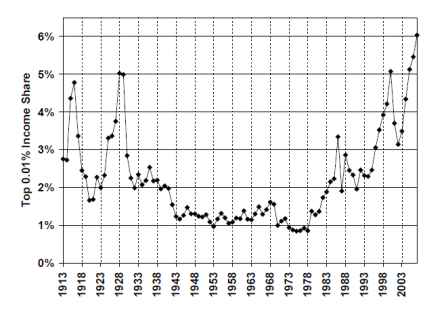
Great Graph from Paul Krugman
This image is powerful...
What does this show? Well the great times of wealth polarization were 1928, directly prior to the great depression, and the first decade of the 21st century. Why does wealth polarization lead to depressions? It is very simple. It is like monopoly, when the common person, the middle class, has very little discretionary funds, then demand falls and depressions/recessions happen.
In the 2008-2009 example, the falling demand was temporarily held at bay by increasing the value of homes and thus giving the false perception of wealth to any people. These people then leveraged their wealth by taking out seconds on their homes. This cycle put cash in people's pockets and a surge of demand. But when the bubble burst, the true lack of wealth amongst most consumers was revealed and consumer confidence, (i.e. demand) fell drastically.
So the real cause of the problem is the polarization of wealth. Thus, the biblical solution - Jubilee. Jubilee is a time of wealth re-distribution and the forgiveness of debts. In our day this is known as, bankruptcies and loan modifications.
brad
This image is powerful...
In the 2008-2009 example, the falling demand was temporarily held at bay by increasing the value of homes and thus giving the false perception of wealth to any people. These people then leveraged their wealth by taking out seconds on their homes. This cycle put cash in people's pockets and a surge of demand. But when the bubble burst, the true lack of wealth amongst most consumers was revealed and consumer confidence, (i.e. demand) fell drastically.
So the real cause of the problem is the polarization of wealth. Thus, the biblical solution - Jubilee. Jubilee is a time of wealth re-distribution and the forgiveness of debts. In our day this is known as, bankruptcies and loan modifications.
brad
Tuesday, January 06, 2009
Easy to Understand Krugman on Stimulus
Stimulus arithmetic (wonkish but important) - Paul Krugman
Around where I hang out, people are knee jerk anti-government. I avoid the topic as much as possible, but if anyone is interested, the above Krugman article explains the need for government intervention pretty well. Krugman has been very good over the past week so read all his blog and his op-eds to get what I think is at least an intelligent discussion of the options.
Friday, October 24, 2008
Debt as a Percentage of GDP
Here is a fact. By the late 1940's the debt as a percentage of GDP was about 110%.
Here is the best graph I can find. It shows the debt from the '50s to present. The point is EXPECT HUGE DEFICITS TO BAIL US OUT OF THE PRESENT CRISIS. The debt could go to about 15+ trillion (GNP is around 12 trillion)

I think the question of sacrifice is a valid one. What is ahead of us is some heavy sacrifices including a season of HUGE deficits followed by an era of higher taxes.
Here is the best graph I can find. It shows the debt from the '50s to present. The point is EXPECT HUGE DEFICITS TO BAIL US OUT OF THE PRESENT CRISIS. The debt could go to about 15+ trillion (GNP is around 12 trillion)
I think the question of sacrifice is a valid one. What is ahead of us is some heavy sacrifices including a season of HUGE deficits followed by an era of higher taxes.
Wednesday, October 22, 2008
The Stimulus Package and The Need for Wealth Distribution
In my first post on the financial crisis, The Depression in the Financial Markets – The Solution is Wage Inflation via Tax Policy posted on September 16th, I suggested that the root cause of our financial woes is ultimately a lack of demand. At the root of this problem is wealth inequality.
The middle class squeeze leads to low consumer confidence. People begin to stop spending. For example, high gas prices pulled people's discretionary funds into fuel and retail sales of items like cars begins to slow. Such a trend begins to spiral into recession. The root cause is a lack of wages rising with prices of vital items. Low wages lead to lowered demand which leads to recession.
In the current crisis, this slowing demand is multiplied by a crisis in the financial markets. The financial crisis has many causes but one of them is that on the fringes people that are squeezed begin to default on their homes. In situations where financial institutions are highly leveraged the result is failed banks.
So what is needed of course is a bailout of the financial institutions by creating liquidity and the government acting as the guarantee of certain failing types of financial services. Basically, the government has to inject into the system more cash. This addresses the financial crisis but what about the recession. The recession is addressed by one fundamental type of action. The government must put money in the hands of consumers. This happens though tax cuts, a stimulus plan and general wealth distribution.
Yes, wealth distribution.
Why Wealth Distribution is Needed
Lets simplify the scenario to make the situation clear. Let's say that one person owns all the food and has all the cash. What will happen to his food selling business. The food will rot and the people will starve. The problem is people cannot buy the food. There is no demand. In this situation, in order to save the wealthy man's business, he has to give money to the consumer. In order to stop a recession and save capitalism requires wealth distribution when wealth inequalities are overly polarized.
Life is like a game of monopoly. If one person has all the money, the game is over. The game comes to a halt. In order to start the game again, you have to give some money to the losers. In times like these, we need demand side economics to drive demand and re-start the economy. Some politicians may call this socialism but in fact this is simply economics 101.
brad
The middle class squeeze leads to low consumer confidence. People begin to stop spending. For example, high gas prices pulled people's discretionary funds into fuel and retail sales of items like cars begins to slow. Such a trend begins to spiral into recession. The root cause is a lack of wages rising with prices of vital items. Low wages lead to lowered demand which leads to recession.
In the current crisis, this slowing demand is multiplied by a crisis in the financial markets. The financial crisis has many causes but one of them is that on the fringes people that are squeezed begin to default on their homes. In situations where financial institutions are highly leveraged the result is failed banks.
So what is needed of course is a bailout of the financial institutions by creating liquidity and the government acting as the guarantee of certain failing types of financial services. Basically, the government has to inject into the system more cash. This addresses the financial crisis but what about the recession. The recession is addressed by one fundamental type of action. The government must put money in the hands of consumers. This happens though tax cuts, a stimulus plan and general wealth distribution.
Yes, wealth distribution.
Why Wealth Distribution is Needed
Lets simplify the scenario to make the situation clear. Let's say that one person owns all the food and has all the cash. What will happen to his food selling business. The food will rot and the people will starve. The problem is people cannot buy the food. There is no demand. In this situation, in order to save the wealthy man's business, he has to give money to the consumer. In order to stop a recession and save capitalism requires wealth distribution when wealth inequalities are overly polarized.
Life is like a game of monopoly. If one person has all the money, the game is over. The game comes to a halt. In order to start the game again, you have to give some money to the losers. In times like these, we need demand side economics to drive demand and re-start the economy. Some politicians may call this socialism but in fact this is simply economics 101.
brad
Subscribe to:
Posts (Atom)