Sunday, September 19, 2010

Orszag on Health Care and Higher Education

A Health Care Plan for Colleges - NYTimes.com
Health Care is still a vital issue effecting America's ability to compete in the 21st Century global environment. In this moment when America's ability to compete is threatened so many roads point to our broken health care system. Orszag's editorial this morning, explains how America's wealth is being funneled into health care and out of the educational and technological infrastructure that will enable America to complete with the other developed countries for middle class jobs.
In this article, Peter Orszag shows the correlation between rising health care costs and the states ability to fund eduction. American health care costs account for 17% of GDP while the next closest competitor nation pays a cost of only 10% of GDP. America pays 70% higher costs for health care. Because health care costs have risen to such a level, during a downturn, these costs put excessive pressure on state budgets. In such downturn generated budget crisis, higher education is the first thing to go. States cut education to pay for the Medicare costs which have risen along with the spiraling health care costs in general. The tragedy is that, when the economy recovers, funding for higher education is not restored to its previous levels. The result is that as health care costs have funneled tax dollars from education to insurance companies America has fallen from 1st to 12th in the percentage of young adults entering the workforce with a college education.
Anyone who runs a business knows that if our costs are 70% higher than our competitors, we are going to lose the competition. In this case, the competition is for capital investment in our economy. Companies invest in the quality of the national workforce and as our educational levels fall skilled jobs will move elsewhere. While other countries invest their tax dollars in education, in America, we pour our precious tax dollars down a sink hole of rising health care costs. This explains why the decision to fix health care in order to solve the structural economic problems was the right decision to salvage he long term prospects of the American dream even if the result is a political nightmare.

Clinton explains rising health care costs on meet the press this morning.

peace, brad

Saturday, September 11, 2010

Matthew 6:19-34 and the Decision to Not Accumulate Wealth

One of the most profound errors in protestantism is the misinterpretation of Matthew 6:19-34. I have spoken concerning this topic many times. The bottom line is that when Jesus says "do not store up treasures on earth where moth or rust destroy but, instead, store up treasures in heaven, for where your treasure is their is your heart" He is calling the Christian to make a decision. This "not storing up treasures" is not a matter of the heart but is a call to not store up wealth in durable goods and money. Money is a form of a durable good like a house in that it can be stored without the value spoiling. This durability is the purpose for money. It is the durability of gold (gold doesn't rust) that led to gold being used as currency. Jesus is clearly playing with the idea of the seeming durability of money in light of more eternal and spiritual, i.e. kingdom, realities.

Many people interpret the passage "for where your treasure is their your heart is also" as saying "for where your heart is there is your treasure also" but that is not what the passage says. It is not where your heart is that determines where your treasure is but where your treasure is that determines where your heart is. If we have treasures on earth then that is where our heart is. If we have durable items stored on earth in the form of money and homes or land, then we must accept that our heart is worldly and carnal and void of the love of God. Therefore, the Christian, the follower of Jesus, is called to make a decision as to whether he or she will seek wealth.


The Problem of Wealth
The human ability to be selfish is manifested in the invention of a means to store up treasures beyond what is natural. This man made means was the invention of currency in the form of durable metals and money. This ability to quantify our wealth in currency has allowed us to "store up treasures on earth". This invention exasperated the problem of inequality. The problem of wealth and unnatural accumulation has been a human problem for a long time. Jesus is not a revolutionary. He is not calling on us to change this reality of the world as it is. Jesus is calling us to live differently and to make a decision.

John Locke was aware of the problem of unnatural accumulation but outside of religion he knew that the state couldn't and shouldn't try to solve this problem. It is just a fact of life that due to the existence of money people can horde wealth. This storing is the primary means that ALL humanity pursues happiness. This storing is ultimately a source of incalculable human suffering. Jesus is calling on Christians through our individual decisions to profoundly impact this most fundamental human problem. the problem of inequality and hoarding. Our response to this teaching of Jesus is central to the mission of the church and the witness of the church.

Jesus is calling the Christian to be different in a real and practical way. We are to make a concrete decision to not store up wealth. This concrete decision to give away our wealth and to refuse to store up money in accounts is the challenge of the passage.

The Decision and the Discipline of Mind
The Christian is called to forsake the accumulation of wealth through his or her labor. This decision is the most counter culture decision of all that the Christian makes. Because this passage is so counter culture and so contrary to all that is around us, precisely because of this affront to our worldview, this passage has been misinterpreted. The Christian must be a critical thinker in order to understand this passage. I have found in life that very few people have the discipline of mind to read the bible for what it actually says especially with respect to Jesus' teachings. The compliant mind assumes that what they have heard from other Christians or from the pulpit is true. This assumption that the church you are in is somewhat correct is the essence of compliant thinking. We must in all things be critical. Because the church is so wrong on this particular issue, we ought to wrestle with this and other hard passages of scripture in the privacy of our own devotional life. This wrestling alone with the text is the essence of being a critical thinker. This takes intellectual courage. What is needed is courageous thinking followed by courageous decisions.

Christians are called to be distinct. We are called to make difficult decisions. These decisions are made not out of fear or compulsion but out of love for God and His ways. We are called to walk by faith. We are called to be courageous. Of all the difficult and courageous decisions we are called to make, I believe this decisions to sell our durable goods and give to the poor is the biggest and hardest decision of all. This decision to empty out our bank accounts and give to the needs of others is a big decision and it is a decision that needs to be made many times over the course of our Christian life. This decision not to save for a retirement of leisure is a big decision, but is there any other way to read Matthew 6? I believe there is not.

Thursday, September 09, 2010

Koran Burning, Civil Liberties and the Fallacy of Political Correctness

Coverage of Koran Case Stirs Questions on Media Role

Here is the bottom line. We live in a very very open society, and there is a price to pay for living in an open society. We have a dilemna becasue a man wants to burn the koran in Florida, and this act puts American service men in danger. Though everything in us tells us that this act has no up-side, we defend this misguided man's right to speak. The fact that, in America, we will not simply stop this man from doing this act of ignorance is a testament that we truly are a free society.

The idea that somehow our liberties are eroding away is quite frankly a bald face fallacy. We live under  the protection of quite possibly the most conservative electorate and the most conservative supreme court in US history. If the state in all its might cannot and will not stop an act of lunacy that puts American service men at harm during a time of war, we must conclude that the idea that our liberties are eroding is utter lunacy.

The reality is this. The American system of liberty is proving itself to be stronger even than the legitimate threat to the life of American service men. American might serves at the behest of the principle that although I disagree with what you say I will defend your right to say it. 
More news, BBC
God Bless America,
Peace,
brad 

Tuesday, September 07, 2010

The Four Story House of Discipleship

One of the most striking deficiencies in the church today is our seeming inability to deliver the kingdom life to our community members. The gospel promises us that the kingdom of God is within our reach. The kingdom is a life that is striking in it's moral distinction. The beautiful and distinct life that is the kingdom is rarely experienced in our churches. Of course, there are numerous reasons for this deficiency including a stunning lack of understanding of the teachings of Jesus and the process through which Jesus leads us into the kingdom life. I call the teachings of Jesus, the wine.
While the teachings are the wine, the diagram above is an illustration of the wineskin. 
The wineskin is the system of institutionalized practices that enables the community to deliver the wine of the teachings of Jesus to the individual. The institutional practices described in this illustration accomplish the task of immersing the members in the words of Jesus and the presence of God. Thus, the foundational concept that this illustration rests on is the reality that the community member needs to be totally immersed in the word and spirit in order to be socialized into this new way of life. Needless to say, these practices are almost impossible to institutionalize in the context of 21st century life. 
The ground up process. 
The other key to this illustration is that the various practices are both synergistic and sequential. The lower layers are more foundational and fundamental than the upper layers (sequential), but in order to perfect the lower layers, we need the assistance of the upper layers (synergistic). The life of private devotion is most important in the life of the believer but the other modes of relationships are necessary to grow in these private disciplines. 

In this blog and in ministry in general, the ultimate goal is to build Morally Beautiful Community. To accomplish this task requires both institutional practices, the wine of the teachings of Jesus, and the power of the Gospel of grace. Hope against hope. One day at a time. 
peace,
brad

Monday, September 06, 2010

Introduction to Karl Popper and Tolerance

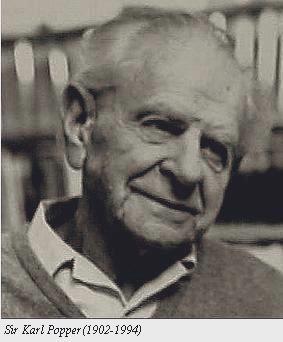
One of the most important thinkers of the 20th Century was the philosopher Karl Popper. Though he is most recognized as a philosopher of science, I believe his work on the defense of the Open Society will become more relevant in the immediate future.

Popper labeled himself a "critical-rationalist". My read on this term is that knowledge is the product of reason and sensory input and not merely sensory experience alone (thus the rationalist part of the term) and, that all our reasonings are theory-laden and prone to perspective laden bias (thus the critical portion of the label). Because Popper accepted that all knowledge is theory laden, he rejected the Newtonian idea of pure objective knowledge. From this premise, Popper narrowed the category of knowledge that is actually scientific to that which is falsifiable. Falsifiability becomes the test as to whether our knowledge can be asserted as scientific.

Critical-rationalism is inherently humble. If one understands that all his knowledge is theory laden, he will be inherently self-critical. This orientation toward one's own knowledge amounts to intellectual humility. One important ramification of Popper's critical understanding of knowledge is his attack on totalitarianism and Marxist historicism. As a result of this application of his theory of knowledge, Popper has a legacy of being a staunch defender of liberty.

Popper's Philosophical Defense of Liberty
Popper explained that a predictive system like Marxism (Marxism claims to predict history), if it is scientific, must be revised when its predictions do not come to pass. Moreover, for a theory to be scientific, it must be possible to construct a test in which if something other than the prediction occurs, the hypothesis is rejected. Marxism, as a system, refuses this type of critic and therefore is non-falsifiable. Popper, therefore, determined that Marxism is a dogma and is inherently non-scientific. This train of thought connects Popper's philosophy of science and his critique of Marxist historicism.

Marxism has the following components that tend toward totalitarianism. First, Marxist historical ideology states explicitly that history is taking a particular path. Marxism makes a prediction. Secondly, as a system of thought, Marxism proves itself to be non-falsifiable because Marxism has resilience against it's own predictive errors. In practice, if a Marxist makes a prediction and the prediction does not come to pass, the Marxist can explain its predictive failure using some caveat of Marxist theory. Thus, Marxism is not scientific because it is not falsifiable, Therefore, Marxism is a dogma.

Such a dogma would be harmless, except that Marxism takes this dogma into the actual realm of politics. Popper's point is that applying a non-falsifiable view of history as the ideological foundation of one's political agenda tends towards totalitarianism. The antidote to this poisonous concoction is liberal democracy. By liberal democracy is meant a democratic system founded on civil rights (e.g. the Bill of Rights).

The conclusion is that to support an open society we must support democratic ideals as opposed to our historicism. All of us bring predictive beliefs about economics and society into the realm of politics, but we must temper our dogma with a commitment to liberty and democracy. In the realm of politics, these commitments must be above all else. For the Christian, this requires a theology which understands the current limited means by which we are allowed to implement the kingdom of God.

Sunday, September 05, 2010

Mystery and Evidence - NYTimes

 I am doing a little series on how non-believers attempt to understand faith. In this article, Mystery and EvidenceCrane is making a few mistakes in his attempt to understand who he is criticizing (i.e. the believer). He seems to apply a criteria for understanding what is religious by a "majority rules" criteria of what defines authentic religious faith. Crane's method concludes that if most religious people experience religion as a way to inject meaning into things then this is what religion is about. But

Everybody Digs Bill Evans - Waltz For Debby

Saturday, September 04, 2010

Stephen Hawking's big bang gaps | Paul Davies

Stephen Hawking's big bang gaps
I think this idea of a God of the gaps is a straw man
(Update: God of the gaps is the idea that faith in God exists to fill in the gaps of our understanding of the universe. A trite view of a retreating God somehow intimidated by the progress of scientific knowledge).
No one who actually has faith has faith on the basis of a God of the gaps. People do not hold faith in order to answer a question of origins or to fill in some cosmological gap. People come to faith in response to a moral and spiritual sense of life. Others seek God to resolve a real life trial or to solve the problem of a character defect. People find resolution to a life problem and experience assistance from God. People who are arguing with this "God of the gaps faith" are arguing without any real living proponent of this position. This is a classic straw man.


Ben Bernanke's monetary policy - What's Next?

Next steps by Chris Payne guardian.co.uk
(This post has been slightly revised.)
This is a dire article. But the gist is as follows: Bernanke has very little policy left. The next actions are to prop up the bond prices up by buying moor securities. They then print money to pay for them. They also need to make a stronger statement that interest rates are going to stay real low for a real long time. This is really just a confidence builder. Really the last thing is to change the targets to desiring inflation. This means that their models change and they take more stimulative action.

Monday, August 30, 2010

Blessed are the Merciful and the Discipline of Mercy

The teachings of Jesus are immersed in a handful of foundational principles. One of these principles is that the follower of Jesus is to be an expert at showing mercy from the heart. The source of this mercy is our abiding awareness of God’s mercy toward us and our continual, frequent and recurrent need for mercy. 
Foundational Principles
Before, we jump into the discipline of mercy, let’s review Jesus’ way of discipleship. First, the first principle of all Christianity is that Jesus is the Christ. Jesus taught us that it is upon this rock, this first truth, that He will build His church. To believe that Jesus is the Christ is to have faith that the answer to the human predicament is solved by Jesus Christ. Jesus came to set the world right. Our faith is that by believing and following Jesus, we will experience a new quality of life. This quality of life is called the “Kingdom of Heaven” or the “Kingdom of God”. This kingdom is from the inside out. Jesus’ teachings center on heart management and life transformation. He teaches us to love our enemies from the heart. He teaches us to be humble and meek and merciful. By following Jesus, the King, we enter and experience His kingdom. This process of following Jesus and experiencing the kingdom is called discipleship. We experience the kingdom as we begin to pattern our lives through the teachings of Jesus. Therefore, we apply the teachings of Jesus in order to enter the quality of life called the kingdom. 

Tuesday, August 24, 2010

Jonathan Edwards on Law and Affection

The Jonathan Edwards makes this incredible point concerning why the law actually drives us to sin and the gospel to holiness. There are certainly people on this earth that are a gift from God and JE is one such gift...
The natural reason why it is as Romans 7:8 ff. [says], "But sin, taking occasion by the commandment, wrought in me all manner of concupiscence," etc. [The]9 reason why man

David Brooks, Dick Cavett and Mayor Bloomberg on the Manhattan Mosque

Numerous articles are being written in response to the Islamic Center in lower Manhattan and the on-going debate about the civil liberties of people of faith. It seems to me unreal that we are even having this discussion in America. Here are a few articles:
A Case of Mental Courage - NYTimes.com
Brooks' point is that, in America, we have lost a theological belief that the battle against sin requires strenuous mental work. This belief led to a strenuous intellectualism. But today our politics betrays an ignorance and a laziness with respect to understanding even the most basic issues like when to raise taxes and when to defend people's civil rights.

This is a must read. The behavior of people who claim the same Lord as I do are so blatantly refusing to follow Him. The racist and fear-based responses of some people of faith is sad indeed.

A highlight of course is Bloomberg's speech.
Hopefully, I will get time to write a more thorough treatment of this topic. I think it is important with respect to mission. People who are confident in the victory of the resurrection of Jesus do not resort to hate and fear as a means to accomplish our mission.

Review of Dave Matthews Band Live August 23, 2010 Hollywood Bowl 8/23/2010

When you wake up the next morning and all you can say to your wife is “WOW, that was pretty amazing”, then, ahhh, you probably saw Dave Matthews last night. Dave Matthews really is that good.
Highlights:
Jam Band Related

Tim Reynolds! It is hard to overshadow Carter Beauford but Tim Reynolds on electric guitar is the one that steals the show. Tim’s tone is perfect. His rig is usually either a strat or a Les Paul through a pair of Mesa Boogie rectifiers. It sounds to me like he is probably playing through the classic mode on the Mesas. The tone is just filled with the classic woody yet nasally midrange. Reynolds job is to make the main riffs that the songs are built around stand out and he does the job perfectly and never misses a beat.

Jeff Coffin from Bela Fleck and the Flecktones really does add a lot to the jam band side of things. It is just great to hear a band that gives a platform for good musicians to play improvisation. On #41, the opening song, Reynolds, Coffin and violin player, Boyd Tinsley, all took extended solos and set a great expectation for the night.

The return to real jam band numbers didn’t come until the end of the show but WOW the last 6 or so numbers at the end was just incredible.

Highlights

Monday, August 23, 2010

Ground Zero Mosque and American Values

This subject deserves a full essay but for now lets just state the themes. First, it is a threat to American values and our liberal democracy to deny freedom of religion to anyone. Christians should be standing up for Muslims to build a center or a Mosque anywhere they please. Secondly, as Christians, we will. It should be impossible for Christians to be baited into fear politics. We have nothing to fear from the world.

It is a sign of the weakness of our faith and the shallowness of our love that Christian leaders are not standing up for the freedom of other faiths. Now that would be a good witness.

peace,

Wednesday, August 18, 2010

Doing Mission Like Jesus - First Impressions


Our Universal Pre-existing Condition
The principles that guide our mission methods differ from the principles of discipleship. Mission is relating to people on the basis of our common humanity. All humanity is in a predicament. Some aspects of this predicament are beyond our control and some aspects of our predicament are self inflicted. Humans suffer from sickness and our natural inability which are thrust upon us by our common humanity. While at the same time, other aspects of our predicament are caused by our sinful and foolish lifestyle choices. In mission, we are not concerned with such matters. We do not question the causes of an individual’s tragic circumstance. Love covers a multitude of sins. We are all the same under the gospel. We are all victims of our own humanity, and we are all responsible to some remote degree for our suffering, but, in mission, we are not concerned with the causes of people’s predicaments. Jesus’ love to humanity is unconditional. The only question that Jesus asks during the mission process, the process of introducing Himself to human beings, is “where does it hurt?”. We all suffer from a pre-existing condition called humanity, and we all need the healer to come set us free. The gospel has no interest in condemning people because we are all already condemned and suffering from the fruit of the folly of our forefathers. Therefore, since we are all the same and there is no distinction, there is no use asking any questions to triage who is qualified for God’s love and mercy. Either we are all qualified for grace or we are all disqualified for grace. The cross of Jesus proclaims clearly, “we are all qualified for grace through the work of Jesus” to the glory of God.

In Mission We are Giving People a First Impression of God
All of us need to build our life with God on a foundation of His grace and love for us. Therefore, in mission we are giving people a first impression of God that is unconditionally loving and gracious. We do not ask the prodigal son or daughter how they got so stinky and dirty. We do not expose but, instead, we cover their shame. We do not interrogate the woman or man caught in the very act of adultery. We simply say “I do not condemn you”. We advocate for sinners and the weak. We bring healing. We are the spiritual Red Cross. The Red Cross brings nursing to both sides of a war. Injured Nazis get medical care from the Red Cross to the exact same level of care and urgency as the American liberator. This is an incredible metaphor for mission. When a dying soldier sees a Red Cross nurse or doctor, he is filled with a glimmer of hope in the midst of his suffering. This is the impression the church is to give to a dying world.

We have a lot of work to do.

Wednesday, August 11, 2010

Doing Mission Like Jesus

I am doing some study for a sermon. The sermon is going to be on doing mission like Jesus. My friend and pastor keith says, "Jesus got invited to all the good parties". This is a great probing phrase because it begs the question, "Do we get invited to all the good parties?" If not maybe we aren't doing mission like Jesus.

So here is a great blog post from Rob Wilkerson on the subject of "Doing Evangelism Like Jesus". Let the revolution begin.
peace,

Saturday, June 19, 2010

Music and the Mind

A Conversation With Aniruddh D. Patel - Exploring Music’s Hold on the Mind
This article discusses important research that reveals how the human brain enables us to sing, dance and play music. The key is that music is the ability to imitate with our bodies, our hands, our voices, what we hear. Music ability is the ability to hear sounds and imitate them. This is why all the great musicians learned music by listening to records or concerts and spending 1000s of hours trying to play what they hear.
My son is going to spend the whole summer transcribing jazz solos. Thanks to "Snowball the Cockatoo".
This article and this video

How to Make Soccer Work for American Fans - Better Drama and More Offense

FIFA 2010 World Cup Scores
Looking at these scores for Group C, the group the USA is in, it is easy to see that soccer has a problem. Three of the four games are ties with only Slovenia defeating Algeria 1-0. The bottom line is that good sports equals good drama.
Because the offense is at such a disadvantage, as proven by the scores, the sport lacks the ability to distinguish between good and mediocre teams. The result is that the sport lacks drama and is rife with controversy.
In American sports, especially American Football, the sports governing authority reviews the rules to encourage more offense and a better experience for the fans. The result is incredible drama, incredible quarterback performances and the greatest fan loyalty of any american sport.

How to promote more offense in Soccer
My idea is simple but revolutionary. Here it is. The current field at the World Cup is surrounded by a fens that is about three feet high. It is the fence covered by the advertisements. I would stiffen up this fence and use it as part of the field. In other words, there would be no out of bounds unless the ball went over the fence. The players could ricochet the ball off the fence. Currently, the fence is slanted up a little. I would make the fence rigid and perpendicular to the field. I would keep it the same height.
Here is the revolutionary part. I would keep the fence as it currently is behind the goal. This way the players could run plays behind the goal like in hockey. This would totally change the scoring.
Now, if the governing body doesn't want to make this as radical a change then they could keep the out of bounds lines of the current system on the ends. But, I think the behind the goal aspect is the key. WOW!!! This would totally make soccer high scoring and the better team could be easily discerned as the scoring would have the ability to differentiate between good and mediocre teams.

Blogging

I realize I haven't been blogging much lately but this blog still gets good traffic so I would like to increase blogging. The problem is my day job goes through very demanding times and I need to keep food on the table and do my job well. For example right now I have to rise at 4:30 to get to work on time and obviously that leave no time for writing in the morning.

Some day, I plan on switching careers and probably going into academia or some type of teaching/writing profession. For now I think I will blog shorter and more frequent posts.

Sunday, May 23, 2010

The Beauty of Discovery and the Discovery of the Way of Happiness

Yesterday, I was reading a book about William Paley and Charles Darwin and I began to tear up. The scientific revolution is so beautiful to me. To me this era was a high point in human history. Deep in my being, I have come to believe that God has made discoverable all his secrets and the greatest dignity a person can experience is the dignity and joy of discovering God’s hidden but discoverable secrets. 
So too, the greatest of the greatest of these joys is to discover God’s way of happiness and yet it is the proclamation that we have discovered something so hidden from most that is so offensive. 
Jesus clearly intended to teach His followers that they are called to discover the way to happiness. Jesus teaches us, “Happy are the poor in spirit, happy and those that mourn etc.” In the Gospel of John, John records these incredible but true sayings of Jesus, “He who drinks of the water that I give will never thirst”. What an absolute promise. If we learn to drink from the wisdom and power of Jesus, we will never thirst. 
Never thirst. Jesus is promising that we will find resolution to every tangled mess of phycological angst and frustration. What I have learned is that of all the promises of Jesus, these promises of joy and peace are the most offensive to the post-modern mind. This postulate that solutions to how to live life can be found and learned and practiced consistently undermines the false premise that no one really knows any real answers. To many, this premise is seen as humility but in reality this pessimism is unbelief. Jesus has promised that we will never thirst. Jesus has taught a path to abiding joy and happiness. To claim that the believer cannot discover these hidden treasures is to call Jesus a liar. But the fact is we serve a God of love who has taught His secrets to babes who are simple enough to put the teachings of Jesus into practice to the same degree and simplicity which Jesus has taught. 
Of all the things I have learned in my life, this is it. God in Jesus has taught us how to be happy. This discovery is available to the follower of Jesus. He has not left us orphans, but He leads us into all truth.  He who seeks finds. When the Son of Man returns will He find faith on the earth. 
Amen

Sunday, May 16, 2010

"Much worse than Expected": BBC News - Monstrous underwater oil plumes found in US Gulf Coast

BBC News - Monstrous underwater oil plumes found in US Gulf Coast
It is possible there will be dead zones in the Gulf 10 miles long and 1 mile wide. This is getting really sad and ugly.
BBC News says:
The find suggests the scale of the potential environmental disaster is much worse than previously feared since the Deepwater Horizon drilling rig blew up on 20 April, killing 11 workers.


We've never seen anything like this before - it's impossible to fathom the impact
Professor Samantha Joye
University of Georgia
Samantha Joye, a marine science professor at the University of Georgia, said: "It could take years, possibly decades, for the system to recover from an infusion of this quantity of oil and gas.
"We've never seen anything like this before. It's impossible to fathom the impact."
The experts say the oxygen depletion is likely to continue, endangering sea life and raising the prospect of underwater dead zones.
The scientists said the chemical dispersants BP has been dumping underwater may be preventing the oil from rising to the top of the ocean.
Official estimates doubted
The oil giant has said the chemicals, which it began deploying on Friday, have already resulted in less oil surfacing.
BP's battle with oil leak continues
Some scientists cast doubt on official estimates of the oil flow rate, saying the widely repeated figure of 5,000 barrels per day dramatically understates the real amount.

Saturday, May 15, 2010

MisIMFormation? - Paul Krugman on the IMF Report

MisIMFormation? - Paul Krugman
The latest from the IMF, which is a survey of the fiscal health of various nations, is a heavy read but Krugman's deciphering is so good I really recommend reading at least Krugman's analysis.
In short, the debt crisis of the worlds advanced nations is not the result of over spending but real structural changes in these economies that has significantly reduced revenues. This is such a no-brainer if you look at the recent history of the United States. The Clinton surplus was the result of actual increased wealth of the entire nation. The Bush deficits and the inherited deficits of the Obama administration are the result of a radical loss of wealth in the economy.
In other words what changes is government revenues as a result of economic changes while spending stays the same. The response is then to find a level spending level and ride out the storm.
I think this is a real clarion call to cease these crazy calls for reduced spending.

Monday, May 10, 2010

Obama: iPad, Xbox Comment

I must say that I agree. I am a firm believer that strenuous thought and intellectual honesty and rigor is a key to happiness. In light of this truth, I must say I agree with Obama on this one. Big Time!!

Obama: iPad, Xbox Turn Information Into A 'Distraction': "'And with iPods and iPads, and Xboxes and PlayStations -- none of which I know how to work -- information becomes a distraction, a diversion, a form of entertainment, rather than a tool of empowerment, rather than the means of emancipation. So all of this is not only putting pressure on you; it's putting new pressure on our country and on our democracy.'"

Sunday, May 09, 2010

Oil Spill - BP scrambles after Gulf oil spill fix setback

BP scrambles after Gulf oil spill fix setback
When I heard this news of the failure of the oil spill fix, my eyes actually started to well up with tears. This is such a drag. It seemed for a bit like we could stop the spill and contain it before the oil began to come ashore, but both hopes were dashed this morning.

I have been advising my children to watch this news event early on as I think it could be a historically memorable event. Unfortunately, the story is getting worse.

I used to work for Alcoa and we had a postulate that "all accidents are avoidable". The oil spill in the Gulf is not an act of God. The oil spill is an accident. The risk simply was not taken seriously. We need to pray and hope for another solution before the gulf area and its economy is decimated by environmental malpractice on the part of the oil companies and their suppliers.

It is the governments job to protect the markets for small business against the abuses of the environment by people who could harm the livelihood of others by their carelessness. BUT again the government for the last 20 years has failed to regulate business. Like the financial deregulation nightmare which is headed for round two, all we the common people can do is sit and watch and pray for a solution that does not harm the livelihood of too many people.

The bible says that the government exists to push back against evil BUT we have failed to regulate the powerful so that these types of evil do not happen. This may not be evil by a common western definition but such accidents are defined as evil biblically per Ecclesiastes. These accidents are always avoidable and it is our job as a people to support government that regulates just this type of thing from happening.

Saturday, April 24, 2010

Climate Change: Key Indicators

Climate Change: Key Indicators
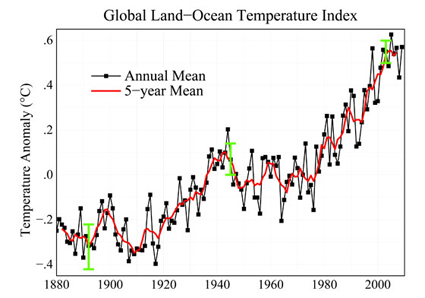
This is a great sight. NASA Global Climate Change. There are charts of long term trends from 1880's to the present.
Like this one:
This is annual temperature changes since the beginning of the industrial revolution (i.e. 1880's). The sight is filled with incredible science. For example, NASA is able through a gravity detecting satellite to detect the mass of the entire antarctic continent to be able to trend changes in the total mass of ice. The antarctic continent is losing 24 cubic miles of ice per year.

The technology used to gather data and make observations is just incredible. 

Saturday, April 17, 2010

iMonk Classic: Why the iMonk (and Me Too) are Not Young Earth Creationists

To Be or Not To Be, or Why I’m Not A Young Earth Creationist
This is a republished article. My views are similar as this statement from Michael Spencer:

The young earth creationists believe that Genesis 1 is “literally” a description of creation. I do not. It is this simple disagreement that is the cornerstone of my objection. I believe that Genesis 1 is a prescientific description of Creation intended to accent how Yahweh’s relationship with the world stands in stark contrast to the Gods of other cultures, most likely those of Babylon. Textual and linguistic evidence convinces me that this chapter was written to be used in a liturgical (worship) setting, with poetic rhythms and responses understood as part of the text. It tells who made the universe in a poetic and prescientific way. It is beautiful, inspired and true as God’s Word.
Does it match up with scientific evidence? Who cares? Here I differ with Hugh Ross and the CRI writers. I do not believe science, history or archaeology of any kind establishes the truthfulness of the scripture in any way. Scripture is true by virtue of God speaking it. If God spoke poetry, or parable, or fiction or a prescientific description of creation, it is true without any verification by any human measurement whatsoever.
I would love to speak on this issue someday but, as yet, I feel such discussions might cause a distraction. But...who knows maybe sooner as opposed to later, I will write out my understanding of the proper approach to Genesis 1.  

Friday, April 09, 2010

Romans 1:16 - The Faithfulness of God

In John 17:3, the Lord Jesus teaches us that life is knowing God. To have happiness in this life, true happiness, requires that we know God. The book of Romans is best understood to not be essentially about "how to get saved" or how we receive righteousness from God, but about God and His righteousness. God is a covenant keeping God. God is faithful. God is holy. When He makes a promise, He keeps it. God is a promise keeping God and Paul is explaining God's faithfulness in the book of Romans. Has God been faithful to the promises to Israel? Has God been faithful to the promise He made with Abraham to through Him bless the entire world? And so opens the book of Romans:
16For I am not ashamed of the gospel, for it is the power of God for salvation to everyone who believes, to the Jew first and also to the Greek.
Paul is not ashamed of the preaching of the Gospel because in the Gospel is revealed the righteousness of God, God's faithfulness. It is in the Gospel that the promise to rescue Israel from exile and bondage is being revealed in sending the Messiah to rescue Israel (and the nations too) and to establish the city promised to Abraham. In the Gospel is being revealed the faithfulness of God.

On the contrary, this opening thematic statement is not saying, "I am not ashamed of the Gospel for in it is revealed a means for sinful humanity to receive a righteousness from God in order to be reconciled to Him". Of course this too is revealed in the Gospel but that is not what the over arching Glory of the book of Romans is about. Romans and the driving force and foundation of our faith is the knowledge of God. The gospel is about God and His faithfulness and this faithfulness to rescue a broken humanity and set the world right and establish the kingdom, this faithfulness of God is being revealed in the Gospel. God has fulfilled the promises to Israel to deliver her from her enemies. He has sent Messiah to rule all the world and those who believe who have faith in His faithfulness these are the people who live and persevere and live in shalom in this life.

Thursday, April 08, 2010

N. T. Wright on Ephesians - Ecclesiology and Justification

It stuns me as I reflect how many times I have read the book of Ephesians and have been unable to incorporate Paul's use of the word "church" in to the themes of this great book. But if you read the book of Ephesians and start with the assumption that Ephesians is about the church, it all comes into focus. 

Think about Paul's use of the word "mystery". I have always been dumbfounded by this theme. Paul says the mystery of the gospel has been revealed to him. As we read we are anticipating Paul to state the mystery clearly and we expect the mystery to be that the Messiah died for sins that we could be reconciled to God. Is not this the great mystery? But alas, Paul's great mystery, the reason he was called is not to proclaim that individuals are justified, but the great mystery is 


the administration of the mystery which for ages has been hidden in God who created all things;10so that the manifold wisdom of God might now be made known through the church to the rulers and the authorities in the heavenly places.
The mystery is the wisdom of God in reconciling both Jews and Gentiles into one church. If you follow the logic of Ephesians the great truth is that justification produces one unified church. Christ has taken away the dividing wall that was the Law and its ordinances and made one body. 

When Paul speaks of marriage he says, "This is a great mystery, But I am not talking about you and your spouse. I am talking about the great mystery of Christ and the Church. Not Christ and the individual, not about marriage, this paragraph of scripture is about Christ and the church, the great mystery. This is ecclesiology!!!

So what is the point. The point is that the purpose of God, the great purpose, is to build a new temple, the church, in our day. This era is the church age and yet we have a low view of the church. God's glory is not just through "life transformation" but church transformation. 

I had a discussion with a young man the other day. He was talking about how people are planning on re-building the temple in Jerusalem and his take was that therefore the end is near. I said in response "but in the New Testament the new temple is the church. Haven't christians been rebuilding the temple for 2000 years. We are the third temple". Yeah, but the temple is going to be built in Jerusalem and then the end will come, he said. What part of "we are the temple don't you understand". My friends the radical wonderful beautiful new temple that is being built to the glory of God is us. Paul saw it and it was this vision that drove him in his journey's. 

That's Paul's perspective and without understanding this perspective we will not understand the radical implications and challenge of the New Covenant. There are many more references to the church in Ephesians but that will have to be for another post. 

Tuesday, April 06, 2010

Brooks is Optimistic - Relax, We’ll Be Fine

Relax, We’ll Be Fine
A great factoid from this article is that the American demographic is actually trending younger due to our rapid population growth. This is an incredibly encouraging and positive sign for American productivity and entrepreneurial competitiveness. Praise God for Immigration!!! Immigration has made us great and will continue to make us even greater!!

Sunday, April 04, 2010

The What and Why of N. T. Wright's Justification

I have been reading N. T. Wright's Justification for awhile now and I just completed the section on Galatians and Philippians. It is hard to understand the distinction Wright is making and why he feels so determined to make it. Even more amazing is why is Piper and crew so vehemently opposed to Wright's way of thinking. I think the point is the underlying worldview between the two positions. So, I will attempt to articulate Wrights point and show how this relates to his worldview "perspective".

Galatians
Where Wright absolutely shines above all other exegetes is his ability to incorporate the entire book into one cohesive argument. Wright includes all the puzzle pieces in discussing the entire picture of the book of Galatians.
Galatians opens with Paul discussing his dispute with Peter. The book is actually about this practical pastoral problem. When the agitators from James (i.e. Jerusalem) came to Galatia, Peter ate in a kind of separate but equal "for-Jews-only" table. The book is about table unity and what constitutes a person's acceptance and identity as "on of God's people". Most interpreters simply skip over this context and instead answer a different question than the one Paul is answering. Isn't the book about how we as individuals stand before God at the judgment? Isn't righteousness the moral quality needed to be accepted into heaven? Here is the subtle difference. The question is actually better stated "What are the cultural markers that define the people of God?" Now here is the point. The reason we formulate the question in an ecclesiological fashion is because God's ultimate purpose is to build a racially diverse and radically beautiful community here on earth. Salvation is manifested in the context not of a future heaven only but in the context of a present church.

This understanding of the big picture of a very practical and present transformed community is the theological foundation to understand Wrights actual distinction. For this reason, Wright emphasizes the covenant with Abraham to make a great nation and inherit the earth and that every nation will be blessed. If this Paul's vision and emphasis, we must incorporate this emphasis in our reading of Paul. The reformers on the other hand were reading Paul to find the answer to a different question that was facing them in their historical context namely the question of purgatory and indulgences. But this question is not the Paul's question. The question then is how is God fulfilling the covenant of Abraham and making this one community out of both Jews and Gentiles and how does this answer in the Messiah answer Peter's hypocrisy in eating at a separate table and faking that he is a Torah follower.

In this context of community building, we must attach meaning to the term "justification". In this context, the first meaning of justification is being accounted as a full member of the community. The sole marker of being a member of the new eschatological community is "faith in the faithfulness of the Messiah". Through this faith in the work of the faithful Israelite, Jesus the Messiah, we are justified that is we accepted in Him as a member of the community. Therefore, to be declared righteous is to be declared a member of the community. Righteousness is a status and not an account of virtue that is great enough to earn heaven.
Here is a way to understand the distinction by looking at a few illustrations.

The Example of Islam, Pharisees, the Qumran Community, and Understanding First Century Judaism
While reading Wright, it dawned on me, "This is exactly the point of Islam!!" Wright makes the point and I am convinced he is correct that first century Judaism never saw perfect attention to the law as necessary to being acceptable before God. Instead the search was for what are the key markers in Torah to constituting being a faithful Israelite. The key is that posing these markers is then reckoned as righteousness. The question is what are the key markers of a member of the people of God. When we see that this is the theology of Paul and first century Jews, then we understand Paul. For the Pharisee the keys were obviously food regulations and sabbath regulations on top of the obvious circumcision and the calendar. For Muslims this is obvious too. The answer to the Muslim is the five pillars. These are the markers of the true people of God. For the Taliban, the signs are a rigorous punishing of the infidel who refuses the markers. This zeal is the marker. For the Christian the marker is faith in the Christ. This is the only marker and this marker is transcends the Law, Torah, and therefore is the great foundation for ethnic unity. This understanding of the quest for definitions of what constitutes community membership is key to understanding Paul and ALL of his books. This the question being answered in Romans, Philippians, and so clearly Ephesians.

The key then to Wright's exegesis is twofold. First, we must make sure we understand Paul and Paul's entire argument and not bring our own perspective to the text. Secondly, we must maintain the worldview of salvation as the membership in the beautiful community here on earth with an eye to this membership being affirmed in the future.

It is this understanding that informs our understanding of the terms "righteous" and "justification".

Application
Here is another key to understanding Paul's emphasis. Christianity becomes more about the moral beauty of the community than our own personal piety. Most western Christians owner story is the story of maintenance of their personal standing with God through confession and repentance. Of course this is important BUT it is not the most important. God's bigger picture, bigger than your personal virtue, is the righteous functioning of the church community. It is the manifestation of the kingdom in the community that we are to emphasize. This perspective, if you will, transforms our priorities and our approach to the faith in a profound way. Sin is now understandably more about love and the one another commands than smoking and drinking and naughty words. The proper perspective on the centrality of community in this life and the purposes of God to build a community to His glory is more important than our journey to heaven. Here is the key to understanding the "what" and "why" of Paul and the New Testament and therefore putting Paul in proper "perspective".

It's Hard to be Humble - Krugman on Alan Greenspan's Revisionist History

Paul Krugman explains how Greenspan was against innovative financial products before he was for 'em.

Financial Reform 101 - Solving the Root Cause of the Financial Crisis

Krugman begins the discussion concerning Financial Reform. There are essentially two positions. Simply put, one solves the problem of the bailout and the other actually attempts to solve the root cause that led to the finical crisis itself.
To me what is so curious is that smart people still have such terrible problem solving skills. The root cause of the finical crisis was not that we bailed out the banks but that the financial system fell apart in the first place.
The two sides of the debate are on the one hand the "too big to fail" side of the debate and on the other hand, the "finical regulation" side. The two big to fail side considers that if these banks weren't so big then their failure wouldn't be so great and therefore we wouldn't have to bail them out. This approach is like saying, "if there were more small stores selling triple cheese burgers instead of one big triple cheese burger big box, then there wouldn't be an obesity problem" The problem is not triple cheese burgers its the size of the cheese burger stores. Obviously this does not provide a solution at all. In the finical crisis, the problem is clearly that the junk the banks were selling should have never been on the market in the first place.
The financial regulation side of the argument says that, "There should be a law against selling the finical equivalent of crack cocaine". Banks should not be allowed to sell highly risky loans and sell these loans to other middle men discussed in mortgage backed securities while holding only 3% reserves. These practices have bitten the world economy twice now. As George Bush would say, "trick me once sham on you, trick me twice well shame on you again , but trick me thrice and well we all are SOL".
Or something like that...