@allisforgiven
@allisforgiven_
Tuesday, January 13, 2015


Monday, October 28, 2013
Populist Libertarianism – The Quest to Disarm the Morality of the Citizen
Populist
Libertarianism – The Quest to Disarm the Morality of the Citizen
The political dialogue in the United States is getting ever
more polarized. The rise of the “tea party” republicans in 2010 was a response
to many factors one certainly being a deep mistrust of the power of the state.
This libertarian, populist impulse opposes any expansion of the use of state
power. After arguing extensively for the use of the state to meet the needs of
people for both security and welfare, Michael Walzer, in Spheres of Justice, makes a parenthetical statement, which I would
like to reflect and build upon. Walzer states, “[this] point [regarding the use
of state power] would hardly have to be made were it not for contemporary
advances of a minimal or libertarian state, who argue that all such matters
(except for defense) should be left to the voluntary efforts of individuals” (SOJ,
kindle 1542)
Since 1983, when Walzer made this observation, the forward
march “of the minimal state” has been steady and drastic. What we have seen in
the subsequent decades, in the United States, is an “advancement” based on the
maxim that “government is not the solution to the problem; government is the
problem” (Pres. Ronald Reagan First Inaugural Address, January 20th,
1981). This idea has captured the political mind over a large segment of the
American political landscape and, in many ways, has infected the entire body
politic. My thesis is that this populist, libertarian ideology has resulted in
great confusion with respect to the state’s moral obligation to its citizens.
The effect of this ideology has been that the political process has been denied
entry into many spheres where the state through political discussion is the
appropriate instrument to undertake projects to meet the general and particular
needs of the citizenry. Furthermore, if distribution mechanisms, other than the
market, are ideologically weakened then those who monopolize money are
empowered to dominate these other spheres. Using the model developed by Michael
Walzer in “Spheres of Justice”, I will attempt to investigate the effects of
this populist, libertarian impulse in American political life and suggest
alternative distribution criterion, which are more appropriate to each given
good. My aim is to convince the libertarian in all of us that the state is
often the necessary instrument with which to more justly distribute key primary
goods.
Applying the Walzer’s
Model to a Critique of Libertarianism
To begin this analysis, I must first define libertarianism
as it is being utilized in the American political discussion by its proponents.
I do not think I will get much disagreement by saying libertarianism is a
philosophy of government that limits government’s role to its minimum. Often
this minimum is limited to the defense of the citizens from enemies within and
without. Secondly, I define libertarianism as populist. By populist, I mean
that it caters to the self-interests of an idealized definition of ordinary
people. In its populist guise, this ideology maintains an anti-elitist stance.
But because it is libertarian, this ideology serves the interests of the wealthiest
Americans by undermining the power of the state to limit the dominance of money
in various spheres. In this sense, populist libertarianism is a type of
false-consciousness in which ordinary people champion an ideology which does
not align with their own self-interests.
Why the State Comes
into Being
Walzer’s depiction of the function of the state seems
somewhat irrefutable. Human beings find strength in numbers. Security is the
first need of the population. The state arises in order to meet this security
need. Because the security needs of the population are so great and ever
present, the state is granted the right to compel able-bodied men to fight.
This is the fundamental social contract. Like the Hobbesian calculus, we give
the state coercive power in exchange for the security of the population. For
the libertarian, this limited social contract becomes a vision for the ideal
state. To the libertarian, to cede to the state coercive powers other than
those needed to combat these limited security needs is to grant the state
tyrannical powers. But when looking at historical examples of the role of the
state, we simply do not see such an arbitrary limitation of the state’s
coercive powers. In other words, such an ideology is nice in theory, but, in
actual practice, such limitations are unreasonable and destructive to political
discourse.
Instead, Walzer does not limit the role of the state to “defense”
but to “needs”. “The criterion of need becomes a critical standard” (Kindle
location, 1409). Nonetheless, it must be understood that “needs are elusive”
and “expansive” (Kindle location, 1394). What is meant by “elusive” and
“expansive” is that each particular setting will define needs particularly. A
simple example is public health. It is commonly recognized that infectious
diseases are a public enemy. Therefore, in the United States there are
mandatory immunizations laws which require vaccination of children prior to
entrance into the public schools. Compulsory vaccination is not beyond the
police powers of the state. This example shows that to limit state power to
defense on the basis of a philosophic ideal provides an absurd limitation in
practical application. The morality of actual cultures cannot reasonably submit
to the libertarian ideal.
Nonetheless, the libertarian mantra continues to hold sway
even in the realm of public health. A movement, at the grass roots level, is
prevalent in the United States against compulsory vaccinations. This sentiment
feeds upon a belief that the state has no right to compel an individual to take a medicine. The
ideology of libertarianism is empowered by the American sentiment which
idealizes individualism and a patriotism which stands up against the tyranny of
the state. The self-identified American patriot feels violated when the state
forces a needle in his shoulder. Even so, sentiment is not the same as moral
clarity. To apply such populist sentiment to the sphere of public health is
morally confused. There is no moral distinction that can be made between
serving one’s country by willingly responding to a compulsory draft and willingly
responding to one’s civic duties with respect to compulsory immunization. The
clarification, which Walzer makes, is to set the criterion for the use of state
powers at “need” and not merely “defense”. Subsequently, when the state uses
its powers to meet these general needs, in this case the need for public
health, the liberties of the individual will be sacrificed. The political
process is essentially a practical discussion concerning what we, the citizens,
decide are the needs which we are willing to use state powers to meet. The
paradigm of maximizing personal liberty by limiting the state to mere defense
is not beneficial to a reasonable populace.
The control of infectious diseases is an extreme example to
show that the state is granted coercive powers to fight public enemies and meet general needs. Other examples
might include protection from fire, protection of the environment, the
regulation of pharmaceutical drugs and other consumer protections. If I take a
walk around my block, I find innumerable examples where the state has used its
tax authority to meet needs, which I cannot imagine any reasonable citizen
would complain about. I walk on a street by a school. I see electrical
power lines bringing electricity to every home. I am drinking a cup of safe
drinking water. I remember as a youth having to come inside due to
extreme air pollution. When I tell my children about the feeling of smog filled
lungs and difficulty breathing, they find my story hard to believe. My
commitment to the American way of life is not merely a commitment to procedural
freedoms like freedom of the press or the right to vote or run for office, but
also a thankfulness for the well-being I experience as a result of the
legislative victories which have enabled us as citizens to meet our general
needs in such a particularly effective manner. As citizens, our loyalties to
the American political process ought not to only celebrate the past, for needs
are elusive and expansive. As history unfolds, new needs arise and new
challenges present themselves.
Economic Catastrophe
The above analysis of the role of the state has supported
the application of a broad conception of the state’s coercive power in order to
meet the general needs of the citizenry. In times of economic catastrophe, the
needs of the population expand. The libertarian ideology seeks to limit the
states response in the midst of such catastrophes. This libertarian agenda to delegitimize
the role of the state to coercively extract resources from citizens of means in
order to provide for citizens in need does not align with the morality of the
American citizenry. By legitimizing the needs of citizens in times of economic
crisis, the power of the state to use its tax authority to meet these needs is
likewise legitimized.
Economic Catastrophe
and Acts of God
The financial crisis of 2008 reveals additional enemies
which threaten the availability of numerous necessary goods. When a hurricane
ravages a coastal community leaving tens of thousands homeless, the nation
provides assistance. Such an event is termed an act of God. This terminology is
used to illustrate that those who suffer are not suffering on account of their
own lack of character or poor choices. Hurricanes are indiscriminate. So too,
an economic disaster harms individuals both severely and indiscriminately. The
economic contraction of 2007-2009 resulted in the loss of 8-9 million jobs and
over $6 trillion dollars in middle class housing wealth. Surely, a factory
worker in California is not to blame for the decisions of a banker in New York
or a policymaker in Washington. There remains controversy over the actual
causes of the recession, but there surely ought to be consensus that a
construction worker in San Diego or a car dealer in Iowa is being harmed by
powers beyond her control. As Americans, we are averse to providing for a
persons needs when their condition is self-inflicted, but unemployment during
an economic catastrophe is no more self-inflicted that the damage done to a
home as the result of a natural disaster. In the same way that the Federal
Government declares a natural disaster in order to provide relief to victim of
an earthquake in California or a flood in Missouri, so too a society can
experience an economic disaster which requires drastic actions by the Federal
Government.
As Walzer stated above, “this point would hardly have to be
made were it not for contemporary advances of [champions of] a minimal or
libertarian state”, but in fact there remains champions of just such a state. As
I have shown, this libertarian ideology is not morally cohesive. Unemployment
in the midst of an economic catastrophe requires a state response. It is our
moral obligation to come to the rescue of our fellow citizens who suffer as the
result of something that they have no power to prevent. A vigorous response to
meet the needs of our neighbor citizens is a moral obligation. In order to meet
these moral obligations, we act as citizens. The only means to make this
response is to tax citizens of means lest we create additional hardship. What
is in question then is the precise nature of the state’s response.
Having determined that our fellow citizens have legitimate
needs during such an economic crisis, it is important to define their actual
need. Picture a husband and father with two small children. He is an engineer
by trade. During the economic crisis, the company that employed him could not
get working capital. The company went bankrupt. Such a scenario, with slightly
different details, happened literally millions of times during the great
recession of 2007-2009. What do these men and women need? Do they need food?
Yes. Do they need continued income support to pay their mortgages? Yes. Do they
need dignity and the opportunity to work? Yes. What these men or women need are
jobs. Having clarity with respect to our moral obligations to one another and
what needs are to be met affects our policy decisions. In such situations,
America has traditionally provided massive stimulus projects. The government
goes to work employing millions and makes good use of the available skills and
labor to invest in our nation. In such a situation, nothing is more disabling
to our moral agency than the idea that “government is not the solution to the
problem; government is the problem”.
Wednesday, November 28, 2012
Tuesday, November 27, 2012
John Rawls: A Theory of Justice Part 1 - The Enlightenment Experiment
Admittedly, I am late to the table concerning John Rawls, but I am becoming quite the fan. I am currently reading "A Theory of Justice" having read, earlier this year, "The Law of Peoples".
 What I will be doing is journaling my thoughts as I read this monumental work of moral philosophy. My audience for much of what I write is the American evangelical but also more broadly the American electorate. Having studied a bit of Rawls this year, I am coming to the conclusion that Rawls should be mandatory reading for all Americans, probably best as college freshmen. Of course, such a suggestion is merely wishful thinking, but one can hope that the American electorate could become well informed and thoughtful in light of the irrationality that marked the 2012 election cycle.
Rawls is a Newtonian figure in the realm of political philosophy. What Newton was to modern physics I believe Rawls is to moral and political philosophy. Rawls makes all things clear when considering how political life ought to work, which brings me to my first point. Johns Rawls is a pillar in the endless line of splendor that is the enlightenment tradition.
The enlightenment is based on the idea that through reason mankind can discover the path to ever increasing peace and prosperity. The works of John Rawls and especially "A Theory of Justice" lays forth a methodology by which men and women of reason may discover a conception of justice upon which they can agree. Such a conception of justice becomes the foundation of a well ordered society and, thus, such a program becomes a step forward in the enlightenment experiment. I find such an appeal to reason glorious and dignifying. The vision of the enlightenment can be quite motivational, but likewise, to lose the vision and quest of the enlightenment can be quite disheartening. Such a cynicism rooted in a rejection of the enlightenment principles that assume solutions to fundamental problems can be solved at least partially leads to political and social apathy. The study of Rawls can be a means to overcome such apathy, but it seems that to find inspiration from Rawls, we must first address two obstacles.
First, the enlightenment experiment involves faith in reason. There then is the problem of man's political nature. In our current political and social environment, partisanism appears to be undermining the role of reason in the decisions of the various political actors. Would a reading of the likes of Rawls by the American electorate tip the scales from purely political considerations in the decisions of political actors to a more principle-based problem solving founded on a common conception of justice. Needless to say, a more principled and thoughtful politics would be welcomed. A reading of Rawls can help us embrace such a quest for public reasoning based on a common conception of justice.
While the obstacle of our political tendencies poses a threat to a more enlightened approach to our political life, our cultures post-modern tendencies likewise poses an obstacle. By post-modern, I mean the belief that all opinions are equal. Ought not an opinion which is based in fantasy as opposed to fact be discredited in the marketplace of ideas, yet it appears of late that such a naive proposition is not a given. In fact, the reality that a fantasy based opinion can survive public discourse is a threat to the enlightenment experiment that is liberal democracy. But maybe just maybe, an appeal to education, indeed an education in the writings of John Rawls and the like, might just give a shot in the arm to our ailing experiment.
Monday, November 12, 2012
The Need for a New Theological and Political Wineskin
Last night, I heard a theologian teach at our church. He started by saying he was very depressed because we are losing the war for evangelical Christianity in America. Needless to say, his depression had to have something to do with the election. He tried to hide his partisanship but it leaked through.
He was absolutely horrible, but I am heartened. He was an old man, and I think he represents an old way of thinking. At least I can hope.
This theologians point was that Christians need to learn how to think and persuade people to our way of thinking. He decried the anti-intellectualism in the church. He completely missed the point. The problem is not that we do not think enough. The problem is that the conservative evangelical theological system makes people anti-intellectual. The problem is that any theology which purports that the earth is 10,000 years old cannot be intellectual. What is needed is a new theological framework, a new wineskin to hold the wine of scientific FACTS. If we cannot reasonably and elegantly address the facts, then we cannot be intellectual or thinking people. The problem is that the 20th century conservative hermeneutic is not capable of addressing scientific fact. Therefore, a new hermeneutic is needed, a new wineskin.
This theologian was forlorn about the votes on homosexual marriage. If we cannot support equal rights and liberty for ALL, then we cannot have a place at the table of democracy. We need a new political philosophy that shows a compassionate and grace filled face to the Church in the political arena. It is so obvious that Christians are supposed to be the voice for the poor in America. Instead, we are seen as people who believe that what is on God's mind is the idea that homosexuals want rights under the law. In a democracy, it is fine to believe that BUT it is not the basis of a political philosophy. The American political system is founded on the motto of e pluribus unum. The American experiment is an experiment centered on belief that the a diversity of peoples can become one people. This political philosophy by definition must not bring our religion into our politics. Unless we develop a political philosophy based in a commitment to civil liberties and a passion for justice, we cannot be intellectuals in the realm of politics.
What this theologian didn't realize is that what created the anti-intellectualism is the inability of his generations theology to incorporate scientific facts and to understand the relationship between religion and politics under our constitutional democracy. What is needed is better ideas not doubling down on the failed ideas of 20th century evangelicalism.
Thursday, October 04, 2012
Presidential Debate Obama / Romney: What President Obama Should Have Said
I am a firm believer that democratic ideas are the solution
to the current economic problems. That democrats have the
solution to economic problems is certainly not always the case. To articulate
the democratic ideas on the economy, this is what President Obama should have
said.
During the first debate session, Romney and Obama went back
and forth on reducing taxes for businesses with Romney stating the 50% of
American workers work for successful small companies whose taxes would go up
under President Obama’s plan. These companies, Romney strongly asserted, are
the job creators. Romney then re-iterated the Republican talking point that the
Obama administration is penalizing success. To this line of reasoning Obama had
no answer.
Here is the correct answer which the President could have
made. I would have said the following:
The problem with Governor Ronmey's one size fits all, supply side solution is
that he states what appears on the surface to be a valid point but is simply bad
policy in the current economic environment. Today, corporations small and large
are holding onto a record level of cash. To lower tax rates on these companies
will give companies better after taxes cash on hand, and only add to the record cash on hand that companies are already not spending on growth and hiring. The problem is that
companies are not spending because they do not have enough demand from consumers
to grow their businesses by spending more money. The reason for this is because
Republican policies over the last 30 years, supply side economics, have
funneled money to the top income brackets and left the middle-class squeezed
and buried. Therefore, in order to increase demand for goods and services and
grow the economy from the middle out ALL tax decreases need to be focused on
the middle-class. We are in a economic situation, caused by republican supply
side blind-ideology, which has consistently reduced the buying power of the
middle-class. Therefore, let me say this again 100%, ALL, tax relief in my
proposal is focused on the middle class . Again, to grow the economy from the inside out, we must focus ALL our
tax relief on the middle-class so that they can energize economic growth
through increased consumption.
Monday, October 01, 2012
Discipleship – Intro: Discipleship and the Need for a Spiritual Revolution
SPIRITUAL
REVOLUTION
When I first started writing publically about the church, I started this blog, “21st Century Reformation”. That was 2003 or about 10 years ago. In those years, the emphasis was simply to take seriously the teachings of Jesus and to apply them in a practical way. I was pastoring a church and later participated in a church plant. Both communities evolved into something that, in light of my reading of the scripture, did not look like the early church. Many of my friends encouraged me to meet people half way and to be more “realistic”. The last few years I have tried that half-measured approach for myself, and I have found this road does not make me happy. Therefore, today I return to my first love and am beginning a new quest to walk a road of continual spiritual revolution. Personally, my heart will only find its home in the midst of a community committed to this spiritual revolution. Let the journey and the struggle begin anew.
God Plan for Human Community Remains the Same
Likewise, would anyone describe the church of today as revolutionary? The early church lived communally, “had all things in common”. “There was not a needy person among them, for all who had lands or houses would sell them…and they would distribute to each as any had need”. Does this describe the church today? Is not the church a staunch defender of the status quo? Is the church meeting the material needs of the world in a revolutionary way? Is materialism a problem in the church as it is in the world? Is simplicity the norm? Is our generosity extravagant? Is the church revolutionary like the early church was?
What the world needs is a spiritual revolution. Our spirituality must set us truly free, and this freedom must express itself in a distinctly Christlike ethical response to the world we encounter. Our world is drowning in injustice and in need of a people free enough to make personal material sacrifices which meet this injustice with compassion and empathy.
When I first started writing publically about the church, I started this blog, “21st Century Reformation”. That was 2003 or about 10 years ago. In those years, the emphasis was simply to take seriously the teachings of Jesus and to apply them in a practical way. I was pastoring a church and later participated in a church plant. Both communities evolved into something that, in light of my reading of the scripture, did not look like the early church. Many of my friends encouraged me to meet people half way and to be more “realistic”. The last few years I have tried that half-measured approach for myself, and I have found this road does not make me happy. Therefore, today I return to my first love and am beginning a new quest to walk a road of continual spiritual revolution. Personally, my heart will only find its home in the midst of a community committed to this spiritual revolution. Let the journey and the struggle begin anew.
God Plan for Human Community Remains the Same
42 They were continually devoting
themselves to the apostles’ teaching and to fellowship, to the breaking of
bread and to prayer43 Everyone kept feeling a sense of awe; and many
wonders and signs were taking place through the apostles. 44 And
all those who had believed]were together and had all things in
common; 45 and they began selling their property and possessions and were sharing
them with all, as anyone might have need. 46 Day
by day continuing with one mind in the temple, and breaking bread from house to
house, they were taking their meals together with gladness and sincerity of
heart, 47 praising God and having favor with
all the people. And the Lord was adding to their number day by day those who
were being saved.
And again in Acts chapter 4, the church is described as “32 And the congregation
of those who believed were of one heart and soul; and not one of them claimed that anything
belonging to him was his own, but all things were common property to them.
33 And with great power the apostles were giving
testimony to the resurrection of the Lord Jesus, and abundant grace was upon
them all. 34 For there was not a needy
person among them, for all who were owners of land or houses would sell them
and bring the proceeds of the sales 35 and
lay them at the apostles’ feet, and they would be distributed to each as any
had need.
The biblical description of the early
church depicts a community that is both spiritual and revolutionary. Can this
be said of the church today? Is the church spiritual? Martin Lloyd-Jones, one
of the greatest preachers of the 20th Century, described the
church’s greatest problem as “superficiality”. Is not superficiality in
opposition to spirituality? Spirituality seeks to heal what really ails us. A
healthy spiritual community develops a spiritual program that helps others find
this healing, this freedom, this truly happy and heavenly quality of life. Are
today’s Christians distinctly more spiritually healthy and beautiful than the non-Christian?
Are our behaviors and attitudes distinct? Would the on-looker describe the peace and
endurance of the modern Christian as stunning and awesome? If not, then, we are
not yet spiritual.
Likewise, would anyone describe the church of today as revolutionary? The early church lived communally, “had all things in common”. “There was not a needy person among them, for all who had lands or houses would sell them…and they would distribute to each as any had need”. Does this describe the church today? Is not the church a staunch defender of the status quo? Is the church meeting the material needs of the world in a revolutionary way? Is materialism a problem in the church as it is in the world? Is simplicity the norm? Is our generosity extravagant? Is the church revolutionary like the early church was?
By revolutionary, I mean a community
that is living by an entirely different set of ethical rules than the world
around us. To be revolutionary always requires a revolutionary relationships
with material goods and a revolutionary concern for others. This is exactly
what is described in the early church. Plainly, poverty and inequality is a
problem in the world and always has been. This problem of inequality was solved
in the revolutionary lifestyle of the early church. We cannot call ourselves a
biblical community unless we are similarly living a revolutionary lifestyle.
The church is neither radically
spiritual nor radically revolutionary, and, unless we become both spiritual and
revolutionary, we cannot be the solution to the human problem. Yet, this is
exactly what it means that Jesus is the Christ and that we are His disciples.
Jesus came to solve the human problem of injustice and man’s inhumanity to man,
and this solution is to be shining forth in the church.
What the world needs is a spiritual revolution. Our spirituality must set us truly free, and this freedom must express itself in a distinctly Christlike ethical response to the world we encounter. Our world is drowning in injustice and in need of a people free enough to make personal material sacrifices which meet this injustice with compassion and empathy.
The early church is a description of
the prototype of the church as fashioned by the disciples of Jesus. These men
and women, discipled in the footsteps of Jesus, lived radically distinct lives
filled with spiritual power and material generosity. The early church lived in
a state of spiritual revolution bringing a revolutionary lifestyle of worship,
prayer and simplicity to a world filled with violence and poverty. Until the
church looks like the early church, we will not change the world like the early
church changed the world. Until the church makes disciples like Jesus made
disciples, the church will not look like the community of the disciples of
Jesus.
It is not time to move the deck chairs
on the Titanic. It is time for a spiritual revolution.
Tuesday, September 25, 2012
As Clinton sounds interest rate alarm, a Warning Against a Do-Nothing Congress
As Clinton sounds interest rate alarm, will reason prevail?
The cost of politics as usual is very high. If Congress takes the stance that the best politics is to assure that the other guys fail, real people will get hurt.
Monday, September 24, 2012
Fiddling at the Fire by Nouriel Roubini - Project Syndicate
After compiling all the elements of the future perfect storm leading to potential global depression, Roubini states the cause:
Ineffective governments with weak leadership are at the root of the problem. In democracies, repeated elections lead to short-term policy choices. In autocracies like China and Russia, leaders resist the radical reforms that would reduce the power of entrenched lobbies and interests, thereby fueling social unrest as resentment against corruption and rent-seeking boils over into protest. But, as everyone kicks the can down the road, the can is getting heavier and, in the major emerging markets and advanced economies alike, is approaching a brick wall. Policymakers can either crash into that wall, or they can show the leadership and vision needed to dismantle it safely.
This confirms the fundamental truth that problems can be solved. All problems have solutions, but, as is so often the case, the primary players' political agendas trump reason. Fiddling at the Fire by Nouriel Roubini - Project Syndicate
Thursday, March 15, 2012
Thursday, December 22, 2011
Violence Returns to Iraq - democracy and Military Action
Wave of attacks kills dozens amid Iraq's upheaval
The lesson here is to reassess how democracy promotion works. We cannot expect to be successful by enforcing democracy via military action. The entire endevor may prove to have been a total waste of lives and money.
Lesson learned: Empire isn't a good long term strategy for prosperity.
Saturday, December 10, 2011
Bias Justice in Alabama: Executive arrested under Alabama immigration law
Mercedes-Benz executive arrested under Alabama immigration law
A basic premise of justice is that justice must be without bias. Laws cannot favor the poor or the rich. No one is above the law. This principle of justice, obviously, is not understood by the good people of Alabama where a law is being reconsidered because it has been found to possibly harm rich folk.
Would a false arrest of a spanish speaking tax paying maid lead to the over turn of a law in Alabama or must the person falsely arrested be rich? The answer is obvious. Poor brown skinned people have been complaining about this law and others like it for months, BUT, as it turns out, the long arm of the law is only comfortable reaching downward.
This case is a perfect example of bias and, therefore, an unjust law which should be overturned regardless of who is being falsely arrested.
Saturday, December 03, 2011
US Lawmaker Blocking Obama’s Pick for Ambassador to Russia
US lawmaker blocking Obama’s pick for ambassador
Michael McFaul is the most clear eyed observer of Russia on the planet. He has legitimate pro-democracy street cred. If anyone thinks Mike will be fooled by Putin, they are either ignorant of Dr. McFaul's history or they simply are being disingenuous. You choose.
Is Modern Capitalism Sustainable? - Kenneth Rogoff - Project Syndicate
Is Modern Capitalism Sustainable?
 As we think about "The Kingdom as Justice", it is helpful to take a self-critical look at our understanding of the world's political economy. What about our political-economic system is unjust? How are people and future generations harmed by a lack of care for the economy, the environment and our debt burden? Is it not unjust to leave a world of inequality, pollution, debt and rising health care costs to our children to fix? Certainly God cares about the well being of our children and has his sights on the well being of our children's children. Can inequality continue to go unchecked? The question is how do we fix these problems that are quickly evolving into crisis due to our petty self-interests and our lack of intellectual rigor.
 As we think about "The Kingdom as Justice", it is helpful to take a self-critical look at our understanding of the world's political economy. What about our political-economic system is unjust? How are people and future generations harmed by a lack of care for the economy, the environment and our debt burden? Is it not unjust to leave a world of inequality, pollution, debt and rising health care costs to our children to fix? Certainly God cares about the well being of our children and has his sights on the well being of our children's children. Can inequality continue to go unchecked? The question is how do we fix these problems that are quickly evolving into crisis due to our petty self-interests and our lack of intellectual rigor.
In the above article, Kenneth Rogoff begins to ask questions concerning the sustainability of capitalism in its current form. We too need to look objectively and without bias (especially religious bias) at how to solve these policy problems which are at the heart of the problems of injustice in God's world.
Wednesday, November 23, 2011
John Rawls - Required Reading
John Rawls
It seems only reasonable to me that such great thinkers like John Rawls should be required reading for all Christian leaders AND that the church should be a central place for public reasoning.
Tuesday, November 08, 2011
Did the Poor Cause the Crisis?
It is hard to resist posting an article like this one. Justice compels me.
Been meditating on justice a lot lately.
Sunday, September 25, 2011
Why Greece is so Important - Bailouts and Haircuts
Discussion of Greece proposing the possibility of 50 percent haircut on debt is a very important news item. For a Christian blogger to speak so much about economics might seem strange to some but consider 20th Century Europe's history of financial meltdowns.
First, I think Europe needs to take action to allow peripheral countries an orderly default. The longer the global community waits the greater the risk. My understanding of an orderly default is basically an agreed upon haircut. Banks holding Greek debt agree to write the value down and Greece agrees to pay the new payments on the new debt levels. Though a 50pc haircut seems drastic think about the options of more austerity.
Populations like Greece at some point will rebel against further austerity. Political unrest in Europe is the worst case scenario. Unrest will likely lead to a populist call for a disorderly default. The contagion of such action is completely unpredictable and likely to be more catastrophic than Lehman.
Why is this important? 1. Good policy and orderly cooperative action can avoid total catastrophe. It is vital to realize that while a natural catastrophe like a Tsunami cannot be avoided Financial Tsunamis can be avoided. The math can be done to make a balanced bailout and haircut options that equally effects banks and public services but protects all of us from wholesale disaster. As Christians, we ought to call for balanced sacrifice and wise solutions to avoid undue suffering. This is the compassionate and wise thing to do. 2. Human nature and the realities of life can cause suffering people to do horrible things. Poverty and economic collapse can lead to political instability. These things have happened before and it is unwise to believe that the 21st century is any different than the 20th.
Friday, September 02, 2011
India's Identity Project
With National Database, India Tries to Reach the Poor - NYTimes.com
This is a great article about the India Identity Project. This is a project to register all Indians. India is notorious for leaving its despertely poor behind as it "develops". This project is an aim to monitor and measure the lives of the poor and be able to get these suffering people into the benefits process. The aim is to lower significantly corruption and the cost of India's bearocracy. This is great use of technology to move development forward.
It is also headed by the author of Imagining India, Nandan M. Nilekani. Imagining India is on my bed stand waiting to be read.
Thursday, September 01, 2011
Currently Reading @ 21st Century Reformation

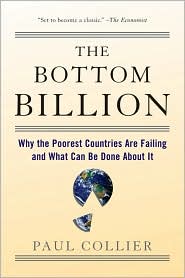
My current reading list on the side bar is a bit outdated I need to update BUT here is what I am reading:
1. I just finished
The Bottom Billion - Paul Collier
2. I am now reading
Development as Freedom - Amartya Sen
Both are fantastic...highly recommended.
Sunday, August 28, 2011
Development or Charity
The Christian Obligation to Be Generous to the Poor
Of all the teachings of Jesus certainly laboring for the well being of the poor is of the most central. Any student of Jesus has to be struck by the ethic of sacrificial love and extravagant giving. Consider this teaching recorded in Luke 12:
29 And do not seek what you will eat and what you will drink, and do not keep worrying. 30 For all these things the nations of the world eagerly seek; but your Father knows that you need these things. 31 But seek His kingdom, and these things will be added to you. 32 Do not be afraid, little flock, for your Father has chosen gladly to give you the kingdom.33 “Sell your possessions and give to charity; make yourselves money belts which do not wear out, an unfailing treasure in heaven, where no thief comes near nor moth destroys. 34 For where your treasure is, there your heart will be also.
In my own contemplation of Jesus, one of the most compelling aspects of Jesus is that more than anyone else Jesus challenges me to serve the poor. Many other passages of the New Testament challenge the follower of Jesus concerning our obligation to generosity. 1 John 3:16-18 commands the Christians,
16 We know love by this, that He laid down His life for us; and we ought to lay down our lives for the brethren. 17 But whoever has the world’s goods, and sees his brother in need and closes his heart against him, how does the love of God abide in him? 18 Little children, let us not love with word or with tongue, but in deed and truth.
Clearly, the Christian is to live by different set of values than those who are not followers of Jesus. As Christians, we are to use any discretionary resources to alleviate the suffering of others as opposed to our own luxury and pleasure. While we are called to serve the poor and suffering of the world, the question remains how ought we to go about doing this.
Many churches have food pantries. Many churches give to emergency relief funds. Is this the limit of our obligation? Are we merely to give charity and supply for the destitute emergency needs.
While we are commanded as followers of Jesus to demonstrate our faith in the love of God by being generous, we are often troubled by the observation that often charity in the form of aid is ineffective. This observation that often charity might actually do harm is quite demotivating. The question of how we are to help and serve the destitute can be answered if we consider the difference between development and charity.
To help understand the difference between development and charity or aid, I will make a few definitions. These definitions are not meant as being necessarily technically accurate but simply to be used as tools to help focus our efforts.
By charity, I mean giving materially to meet the immediate needs of people. The food pantry is a great example of charity. Currently, the world is seeing a famine in the Horn of Africa which may be the worst of our generation. Certainly, in these situations charity is absolutely necessary. These people need emergency aid and to stand by and watch such suffering is cold and inhumane. Nonetheless, wisdom compels us to think deeper about what we can do to help poor communities.
Wisdom compels us to consider the idea of development. Development is the process of growing a person or a community’s capability to provide freedom from suffering for themselves. Development respects the agency of the individual. For example, about one billion people on the planet lack the capability to provide for themselves and their family’s nutrition. In these societies, men and women lack the education or the resources to generate value which can be consistently transacted for food. In these communities, the individuals lack the freedom to avoid malnourishment. The community is underdeveloped to the extent that its citizens lack opportunity. Our obligation is to assist in developing the capacity in these communities to give opportunity to their people. When we can provide such capacities through the application of wisdom and planning and resources, it is development that is our obligation. We are obligated not just to blindly give charity but to wisely assist in development. For example, charity might see the need for medicine while development sees the opportunity to develop a health care system. A health care system includes building nursing schools and for-profit hospitals. In such a system, businessmen build businesses, local nurses gain employment and local citizens gain access to health care. This example illustrates a few important differences between charity and development.
- Development requires leadership. Such a plan to develop, in this case, an improved health care system is a long term project. Intelligence is required to design a long-term plan. Emergency relief has its logistical difficulties but development of a health care system is far more complex. This involves the founding of schools and interaction with government agencies and educational institutions in the West. Such a plan is ambitious, but only such a plan for development actually brings prosperity and dignity to a community. Charity brings dignity to the giver while development brings dignity to the community being developed.
- Development requires long-term commitment. Jesus taught us that when we make a plan to obey Him, we must consider the size of the challenge. Development is a commitment that requires extensive resources: time, money and intelligence. The church is an extensive institution that is prepared to make just this type of commitment. Christians are not alone in their plans to assist the poor of the world. We are perfectly situated to make long-term, even multigenerational, commitments to other communities around the globe.
The time has come for Christians to move beyond charity and consider our obligation to bring to the poor of the world actual development and dignity.
Subscribe to:
Posts (Atom)